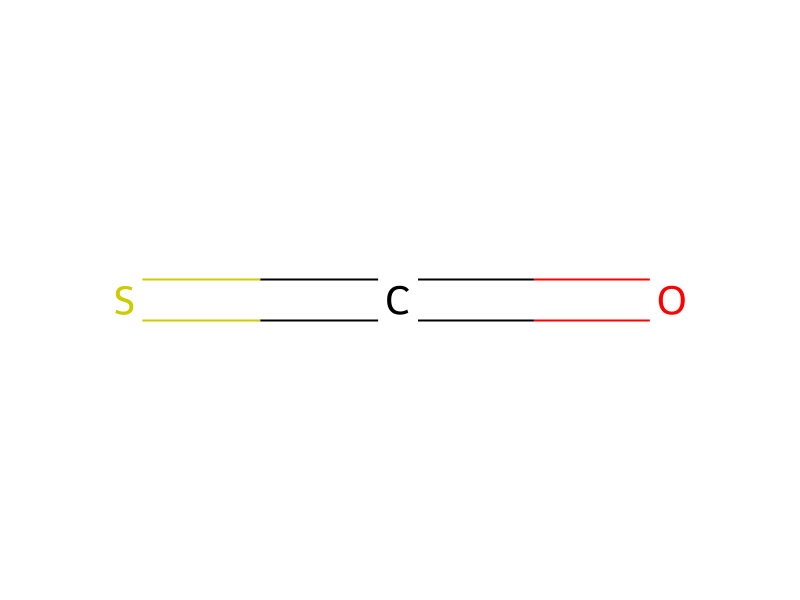
Carbonyl Sulfide → Cyclohexyl isothiocyanate
Reaction equation

[N+:1]([CH:4]1[CH2:9][CH2:8][CH2:7][CH2:6][CH2:5]1)([O-])=O.[C:10](=[S:12])=O>[C-]#[O+].[C-]#[O+].[C-]#[O+].[C-]#[O+].[C-]#[O+].[C-]#[O+].[Mo]>[CH:4]1([N:1]=[C:10]=[S:12])[CH2:9][CH2:8][CH2:7][CH2:6][CH2:5]1Participants
Reactant 2

Product 1

Reagents, catalysts & solvents 1

Conditions
- Temperature
- 150 °C
Procedure
Nitrocyclohexane (0.02 mole) and molybdenum hexacarbonyl (0.0002 mole) were placed in a 100 ml. rocking autoclave which was then sealed. Carbonyl sulfide (10.0 g., 0.16 mole) was charged to the autoclave from a small stainless steel cylinder, in which it was contained in the liquified state under its own vapor pressure (about 160 psig). The autoclave was then heated at 150°C. for 3 hours, after which it was cooled to ambient temperature, vented and opened. The reaction mixture was rinsed from the autoclave with 10 ml. of chloroform. The chloroform solution was separated from an insoluble residue by filtration, following which the solvent was evaporated to give 0.97 g. of product mixture. Vapor phase chromatographic analysis of this mixture showed it to contain 1.0% of nitrocyclohexane and 3.6% of cyclohexyl isothiocyanate (1.3% yield based on unrecovered nitrocyclohexane).
Workup
- customrocking autoclave which was then sealed
- temperatureafter which it was cooled to ambient temperature
- washThe reaction mixture was rinsed from the autoclave with 10 ml
- customThe chloroform solution was separated from an insoluble residue by filtration
- customwas evaporated
- customto give 0.97 g
Sources & evidence
- ORD record
- ord-d7eb1f368b9d4a1290386d68ec3c272c
- Source dataset
- uspto-grants-1976_04
- Patent number
- US03953488
Reaction notes
Loading…