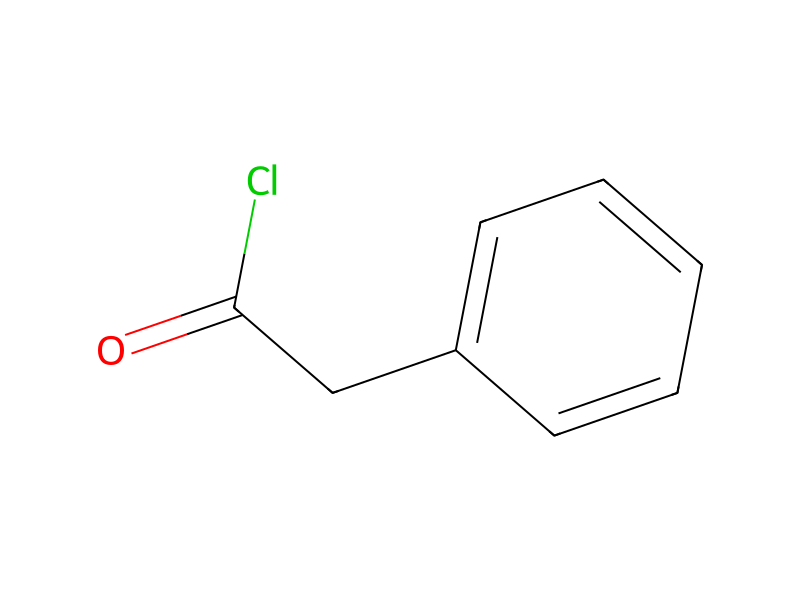
Phenylacetyl chloride → 4'-Chloro-2-phenylacetophenone
Reaction equation

[C:1]1([CH2:7][C:8](Cl)=[O:9])[CH:6]=[CH:5][CH:4]=[CH:3][CH:2]=1.[Cl:11][C:12]1[CH:17]=[CH:16][CH:15]=[CH:14][CH:13]=1.[Cl-].[Al+3].[Cl-].[Cl-]>Cl>[CH2:7]([C:8]([C:15]1[CH:16]=[CH:17][C:12]([Cl:11])=[CH:13][CH:14]=1)=[O:9])[C:1]1[CH:6]=[CH:5][CH:4]=[CH:3][CH:2]=1Participants
Reactant 3


Product 1

Reagents, catalysts & solvents 1

Conditions
- Temperature
- 44 °C
Procedure
To a 2 liter 4 necked flask equipped with a mechanical stirrer, thermometer, and reflux condensor was added 155 g (1.0 mole) of phenyl acetyl chloride and 500 ml (4.9 mole) of chlorobenzene. A total of 145 g (1.08 mole) of anhydrous aluminum chloride was added portionwise over 10 minutes. The mixture self warmed to 44° C. and evolved HCl gas over the course of the next 30 minutes The mixture was stirred at about 50° C. for an additional 30 minutes and then poured onto about 500 g of ice and 110 ml of concentrated aqueous HCl. The organic layer (lower) was separated and the aqueous layer was washed with ethyl ether. The combined organic layers were washed with water, dilute aqueous NaOH, and water and then concentrated in vacuo. The resulting crude solid was recrystalized from 2200 ml of hexane yielding 132 g of 4-chlorophenyl benzyl ketone, mp 85°-90° C. NMR data was consistent with the structure.
Workup
- temperaturethermometer, and reflux condensor
- customover the course of the next 30 minutes
- customThe organic layer (lower) was separated
- washthe aqueous layer was washed with ethyl ether
- washThe combined organic layers were washed with water, dilute aqueous NaOH, and water
- concentrationconcentrated in vacuo
- customThe resulting crude solid was recrystalized from 2200 ml of hexane yielding 132 g of 4-chlorophenyl benzyl ketone, mp 85°-90° C
Sources & evidence
- ORD record
- ord-f2d1e2ee39494febb6776b5dbb5c1722
- Source dataset
- uspto-grants-1989_09
- Patent number
- US04863947
Reaction notes
Loading…