Benzoic Acid → 4-Vinylbenzoyl chloride
Reaction equation

[CH:1]([C:3]1[CH:11]=[CH:10][C:6]([C:7](O)=[O:8])=[CH:5][CH:4]=1)=[CH2:2].S(Cl)([Cl:14])=O.C(O)(=O)C1C=CC=CC=1>C(Cl)(Cl)Cl.[N+](C1C=CC=CC=1)([O-])=O>[CH:1]([C:3]1[CH:11]=[CH:10][C:6]([C:7]([Cl:14])=[O:8])=[CH:5][CH:4]=1)=[CH2:2]Participants
Reactant 3
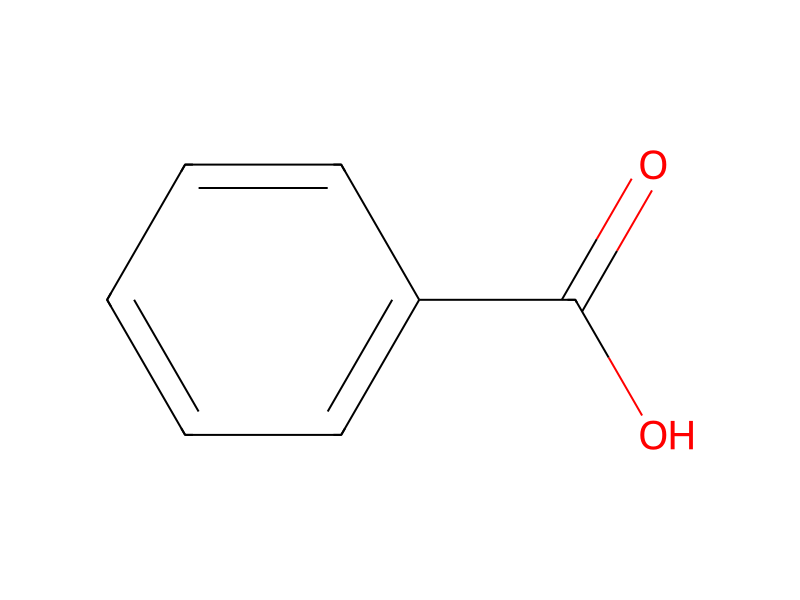


Product 1

Reagents, catalysts & solvents 2


Conditions
- Temperature
- 50 °C
Procedure
4-vinyl benzoyl chloride was synthesized from 4-vinyl benzoic acid (obtained from Trans World Chemicals). The 4-vinyl benzoic acid was dissolved in chloroform with a small (0.16 mole/mole 4-vinyl benzoic acid) amount of nitrobenzene added as an inhibitor to prevent cross-linking. A large excess of thionyl chloride (six times the moles of benzoic acid) was added dropwise while stirring and gently heating to 50° C. Once the thionyl chloride was completely added, and the solution was at a temperature of 50° C., it was allowed to stir for one hour. The solution was then distilled (rotary evaporator) to remove the bulk of the chloroform and unreacted thionyl chloride. The impure 4-vinylbenzoyl chloride was then vacuum distilled to further purify it. At <1 mm mercury the 4-vinylbenzoyl chloride distills at around 70° C. The composition of the product was checked by NMR and was confirmed to be 4-vinylbenzoyl chloride. The yield was 91%.
Workup
- additionadded as an inhibitor
- customwas at a temperature of 50° C., it
- stirringto stir for one hour
- distillationThe solution was then distilled
- custom(rotary evaporator)
- customto remove the bulk of the chloroform and unreacted thionyl chloride
- distillationvacuum distilled
- customto further purify it
- distillationAt <1 mm mercury the 4-vinylbenzoyl chloride distills at around 70° C
Sources & evidence
- ORD record
- ord-d36dd764261d4837b7a95cb6cde136f8
- Source dataset
- uspto-grants-1989_09
- Patent number
- US04868241
Reaction notes
Loading…