Monobenzone → 4-(5-Ethoxy-2,2,3,3,4,4-hexafluoropentoxy)phenol
Reaction equation

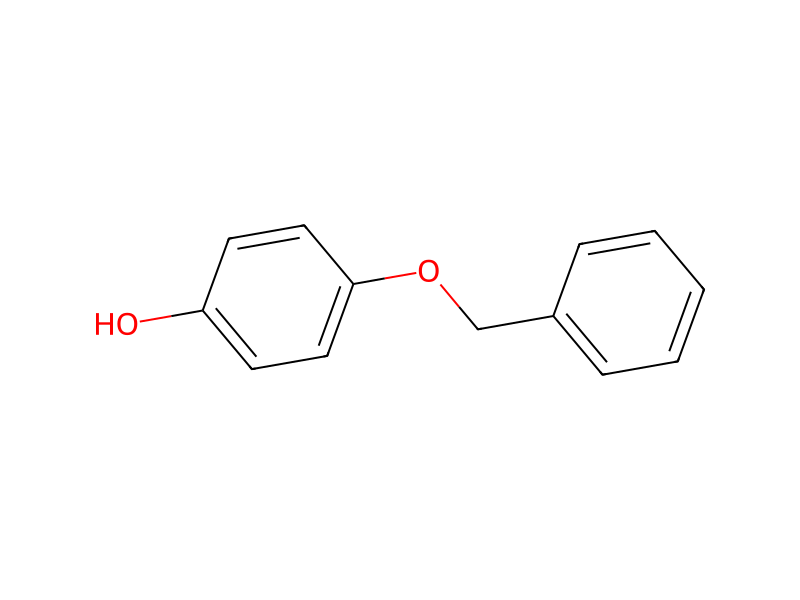
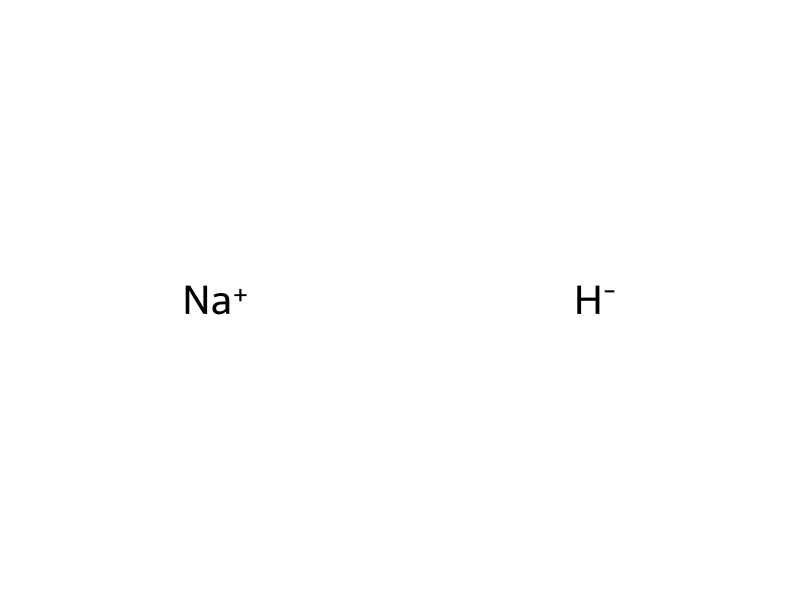
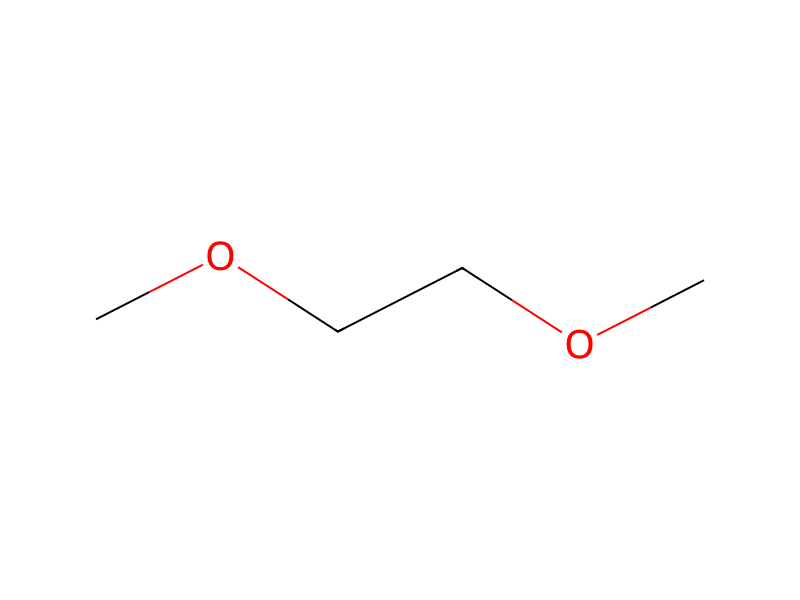
[H-].[Na+].C([O:10][C:11]1[CH:16]=[CH:15][C:14](O)=[CH:13][CH:12]=1)C1C=CC=CC=1.FC(F)(F)S([O:23][CH2:24][C:25]([F:37])([F:36])[C:26]([F:35])([F:34])[C:27]([F:33])([F:32])[CH2:28][O:29][CH2:30][CH3:31])(=O)=O.[O-]S(C(F)(F)F)(=O)=O>COCCOC>[CH2:30]([O:29][CH2:28][C:27]([F:32])([F:33])[C:26]([F:34])([F:35])[C:25]([F:36])([F:37])[CH2:24][O:23][C:14]1[CH:15]=[CH:16][C:11]([OH:10])=[CH:12][CH:13]=1)[CH3:31]Participants
Reactant 4


Product 1

Reagents, catalysts & solvents 1
Procedure
2.8 g of 60% sodium hydride in mineral oil was added to 100 ml of dry 1,2-dimethoxyethane. The mixture was stirred, and 10 g (0.0499 moles) of 4-benzyloxyphenol was added. The resulting solution was stirred for 30 minutes more, then was cooled down to room temperature using an ice bath. 19 g (0.0511 moles) of 5-ethoxy-2,2,3,3,4,4-hexafluoropentyl trifluoromethanesulfonate (prepared essentially as in Example 3) was then added slowly. When the triflate addition was complete, the ice bath was removed, and the product-containing mixture was stirred at room temperature overnight. The solvent was then removed under reduced pressure, and 200 ml of water, followed by 150 ml of diethyl ether, were added sequentially with stirring. Once all of the solids had dissolved, two homogeneous liquid layers formed. The layers were separated, and the aqueous layer was extracted twice with 150 ml aliquots of diethyl ether. The resulting ether layers were then combined, were washed once with 125 ml of 1 N aqueous sodium hydroxide and twice with 150 ml aliquots of deionized water, were dried using anhydrous magnesium sulfate, and were stripped to dryness using a rotary evaporator. The resulting solid was dissolved in ethanol and was hydrogenated for 18 hours at 60 psi (3100 torr) in the presence of a 10%-palladium-on-carbon catalyst. When the hydrogenation was complete, the catalyst solid was removed by filtration, and the solvent from the filtrate was removed using a rotary evaporator. The resulting material was purified using chromatography on silica gel (2.5% methanol in chloroform) to yield 2.85 g of 4-(5-ethoxy-2,2,3,3,4,4-hexafluoropentoxy)phenol.
Workup
- stirringThe resulting solution was stirred for 30 minutes more
- additionwas then added slowly
- customthe ice bath was removed
- stirringthe product-containing mixture was stirred at room temperature overnight
- customThe solvent was then removed under reduced pressure, and 200 ml of water
- additionwere added sequentially
- stirringwith stirring
- dissolutionOnce all of the solids had dissolved
- customtwo homogeneous liquid layers formed
- customThe layers were separated
- extractionthe aqueous layer was extracted twice with 150 ml aliquots of diethyl ether
- washwere washed once with 125 ml of 1 N aqueous sodium hydroxide and twice with 150 ml aliquots of deionized water
- customwere dried
- customa rotary evaporator
- dissolutionThe resulting solid was dissolved in ethanol
- customthe catalyst solid was removed by filtration
- customthe solvent from the filtrate was removed
- customa rotary evaporator
- customThe resulting material was purified
Sources & evidence
- ORD record
- ord-1b77426a56c24a14b29485527ee99199
- Source dataset
- uspto-grants-1995_03
- Patent number
- US05399291
Reaction notes
Loading…