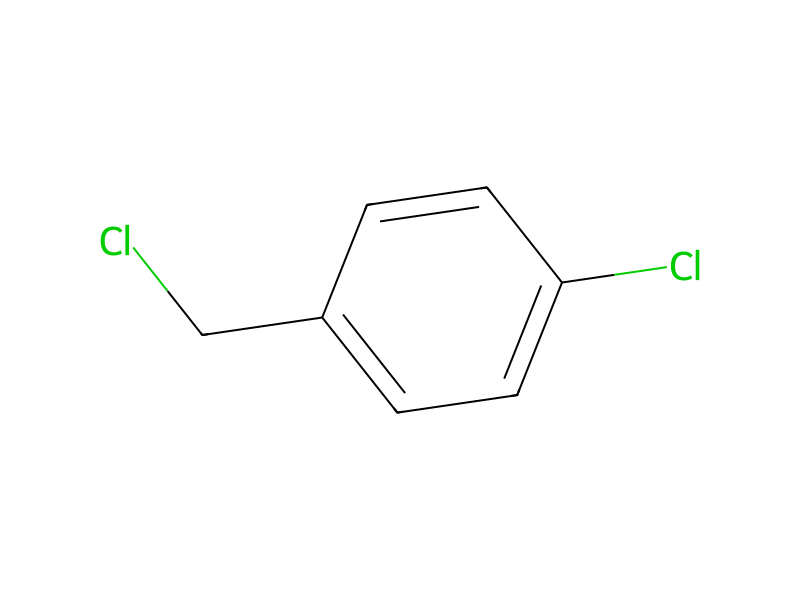
1-Chloro-4-(chloromethyl)benzene → 2-Fluoro-4-(4-chlorophenylmethoxy)nitrobenzene
Reaction equation

[F:1][C:2]1[CH:3]=[C:4]([OH:11])[CH:5]=[CH:6][C:7]=1[N+:8]([O-:10])=[O:9].[Cl:12][C:13]1[CH:18]=[CH:17][C:16]([CH2:19]Cl)=[CH:15][CH:14]=1.C(=O)([O-])[O-].[K+].[K+]>C(C(C)=O)C>[F:1][C:2]1[CH:3]=[C:4]([O:11][CH2:19][C:16]2[CH:17]=[CH:18][C:13]([Cl:12])=[CH:14][CH:15]=2)[CH:5]=[CH:6][C:7]=1[N+:8]([O-:10])=[O:9]Participants
5



Procedure
A stirred mixture of 7.8 grams (0.05 mole) of 3-fluoro-4-nitrophenol, 8.1 grams (0.05 mole) of 4-chlorophenylmethyl chloride and 6.9 grams (0.06 mole) of potassium carbonate in 80 mL of methyl ethyl ketone was heated at reflux for about 18 hours. After this time the reaction mixture was cooled to ambient temperature and filtered. The filtrate was concentrated under reduced pressure to a residue. The residue was subjected to column chromatography using silica gel. Elution was accomplished using methylene chloride. The product-containing fractions were combined and concentrated under reduced pressure, yielding 10.0 grams of 2-fluoro-4-(4-chlorophenylmethoxy)nitrobenzene, mp 86°-88° C.
Workup
- temperaturewas heated
- temperatureat reflux for about 18 hours
- filtrationfiltered
- concentrationThe filtrate was concentrated under reduced pressure to a residue
- washElution
- concentrationconcentrated under reduced pressure
Sources & evidence
- ORD record
- ord-cbf0c2166b76437bbdaaa24232e71c7d
- Source dataset
- uspto-grants-1995_03
- Patent number
- US05399543
Reaction notes
Loading…