Acetic Anhydride → Acetic acid N'-(2,4-dichloro-phenyl)-hydrazide
Reaktionsgleichung

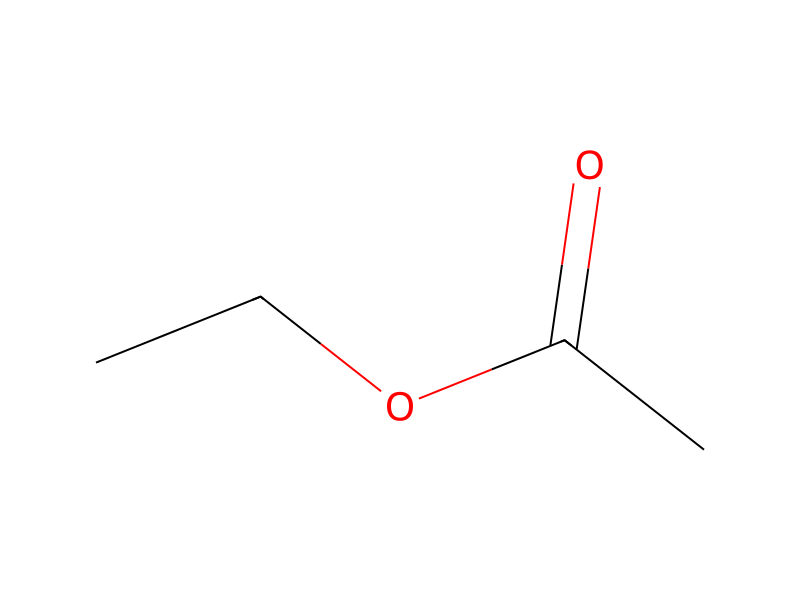
[Cl:1][C:2]1[CH:7]=[C:6]([Cl:8])[CH:5]=[CH:4][C:3]=1[NH:9][NH2:10].[C:11](OC(=O)C)(=[O:13])[CH3:12]>C(OCC)(=O)C>[C:11]([NH:10][NH:9][C:3]1[CH:4]=[CH:5][C:6]([Cl:8])=[CH:7][C:2]=1[Cl:1])(=[O:13])[CH3:12]Komponenten
Edukt 2
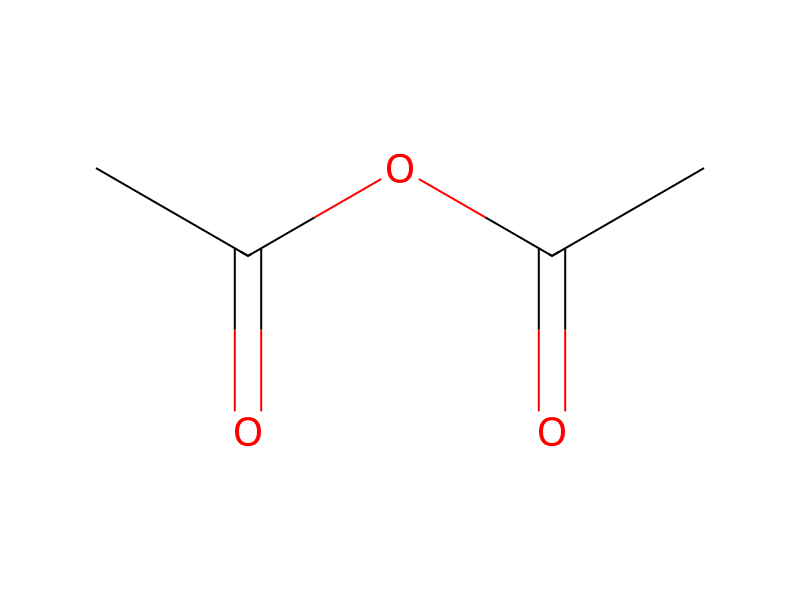

Produkt 1

Reagenzien, Katalysatoren, Lösungsmittel 1
Versuchsvorschrift
Generally in a process of condensing a hydrazonoyl derivative of formula (A) to form a compound of formula (I), the free hydrazine (1) as described above, for example, 2,4-dichlorophenylhydrazine (1) is reacted with acetic anhydride at a temperature of about 10° C. in an appropriate solvent such as ethyl acetate, yielding the corresponding 1acetyl-2-(2,4-dichlorophenyl)hydrazine (2). The hydrazine (2) is then chlorinated with phosphorous oxychloride at a temperature of about 110° C. in an appropriate solvent such as toluene, yielding the hydrazonoyl derivative of formula (A), N-(2,4-dichlorophenyl)ethanehydrozonoyl chloride. The hydrozonoyl chloride (A) is condensed with a ring forming agent, for example, potassium cyanate at a temperature of about 40° C. to about 65° C. in an appropriate solvent such as DMAC, yielding the corresponding compound of formula (I), 45-dihydro-1-(2,4-dichlorophenyl)-3-methyl-1,2,4-triazol-5(1H)-one. The condensing of hydrozonoyl chloride (A) to the compound of formula (I) in solvents such as DMAC is routinely aided by the presence of a catalyst, such as potassium fluoride. A detailed procedure for the preparation, and the potassium fluoride-catalized condensing of the hydrozonoyl chloride (A) with the ring forming agent potassium cyanate in DMAC to yield a compound of formula (I) is set forth in Example 1 hereinbelow.
Quellen und Nachweise
- ORD-Eintrag
- ord-74950f951f424b74890af245acb0739f
- Quelldatensatz
- uspto-grants-2006_01
- Patentnummer
- US06992221B2
Notizen zur Reaktion
Wird geladen…