1,3-Propanediamine, N'-(ethylcarbonimidoyl)-N,N-dimethyl-, monohydrochloride → 2-[(E)-3-(5-bromo-3-pyridinyl)-1-oxo-2-propenyl]-5-[3-(cyclopentyloxy)-4-methoxyphenyl]-1-methyl-3-pyrazolidinone
Reaction equation

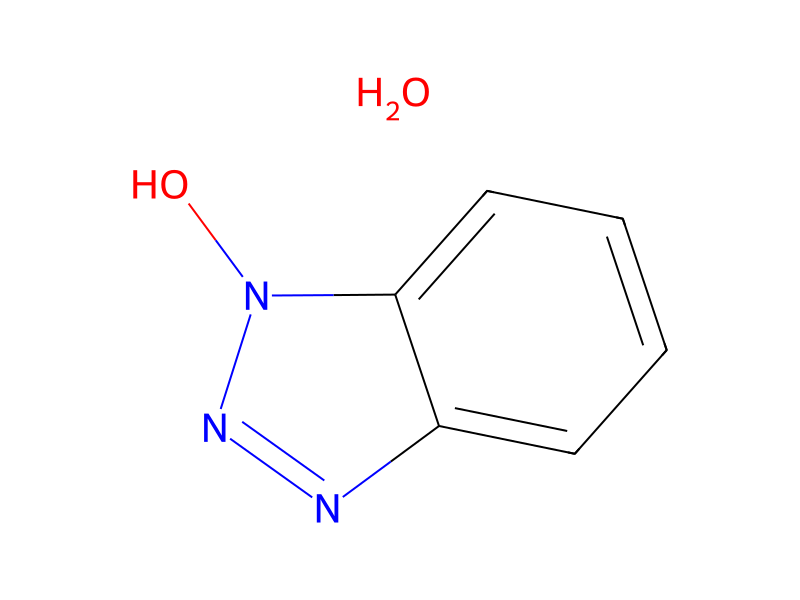
Cl.CN(C)CCCN=C=NCC.O.ON1C2C=CC=CC=2N=N1.[Br:24][C:25]1[CH:26]=[C:27]([CH:31]=[CH:32][C:33]([OH:35])=O)[CH:28]=[N:29][CH:30]=1.[CH:36]1([O:41][C:42]2[CH:43]=[C:44]([CH:50]3[N:54]([CH3:55])[NH:53][C:52](=[O:56])[CH2:51]3)[CH:45]=[CH:46][C:47]=2[O:48][CH3:49])[CH2:40][CH2:39][CH2:38][CH2:37]1>C(Cl)Cl>[Br:24][C:25]1[CH:26]=[C:27](/[CH:31]=[CH:32]/[C:33]([N:53]2[C:52](=[O:56])[CH2:51][CH:50]([C:44]3[CH:45]=[CH:46][C:47]([O:48][CH3:49])=[C:42]([O:41][CH:36]4[CH2:37][CH2:38][CH2:39][CH2:40]4)[CH:43]=3)[N:54]2[CH3:55])=[O:35])[CH:28]=[N:29][CH:30]=1Participants
Reactant 4



Product 1

Reagents, catalysts & solvents 1

Procedure
A mixture of 1-(3-dimethylaminopropyl)-3-ethylcarbodiimide hydrochloride (1.20 mmol, 0.230 g), 1-hydroxybenzotriazole hydrate (1.20 mmol, 0.162 g) and 3-(5-bromo-3-pyridyl)propenoic acid (1.20 mmol, 0.274 g [see Nishikawa, et al, J Med Chem, 32, 583 (1989)] is suspended in dry methylene chloride (20 mL) at room temperature and stirred for 2 hours. To the suspension is added a solution of 5-[3(cyclopentyloxy)-4-methoxyphenyl]-1-methyl-3-pyrazolidinone (1.20 mmol, 0.340 g) in dry methylene chloride (10 mL) and the resulting mixture is stirred at room temperature overnight followed by reflux for 24 hours. The homogenous solution is cooled to room temperature and the volatiles are removed in vacuo. The residue is partitioned between ethyl acetate (50 mL) and 1N NaOH (50 mL), the aqueous phase extracted with ethyl acetate (50 mL) and the combined organics are washed with water (50 mL) and dried (Na2SO4). Concentration in vacuo affords a white foam, which is purified via flash chromatography (SiO2 : concentration gradient ranging from 5% ethyl acetate/methylene chloride to 15% ethyl acetate/methylene chloride) to give the title compound as a white solid which is triturated with ether and hexane and dried in vacuo at 50° C. to provide analytically-pure material (0.52 mmol, 0.260 g, 52%). H-NMR (DMSO-d6, 400 MHz) δ8.82 (d, 1H, J=1.7 Hz); 8.66 (d, 1H, J=1.7 Hz); 8.41 (t, 1H); 7.71 (d, 2H, J=2.4 Hz,); 6.98 (d, 1H, J=1.5 Hz); 6.89 (m, 2H); 4.70 (m, 1H); 4.47 (dd, 1H, J=0.6, 1.7 Hz); 3.70 (s, 3H); 3.65 (m, 1H); 2.84 (s, 3H); 2.77 (m, 1H); 1.80 (m, 2H); 1.62 (m, 4H); 1.49 (m, 2H). IR (KBr, cm-1) 3460, 2940, 2860, 1748, 1660, 1623, 1515, 1445, 1435, 1425, 1326, 1260, 1235, 1208, 1150, 1130, 1015, 990, 962, 848, 680.
Workup
- stirringthe resulting mixture is stirred at room temperature overnight
- temperatureby reflux for 24 hours
- customthe volatiles are removed in vacuo
- customThe residue is partitioned between ethyl acetate (50 mL) and 1N NaOH (50 mL)
- extractionthe aqueous phase extracted with ethyl acetate (50 mL)
- washthe combined organics are washed with water (50 mL)
- dry with materialdried (Na2SO4)
- concentrationConcentration in vacuo
- customaffords a white foam, which
- customis purified via flash chromatography (SiO2 : concentration gradient ranging from 5% ethyl acetate/methylene chloride to 15% ethyl acetate/methylene chloride)
Sources & evidence
- ORD record
- ord-d48ad8b108bb475880d53552594c0ca8
- Source dataset
- uspto-grants-1993_03
- Patent number
- US05191084
Reaction notes
Loading…