Hydrochloric Acid → HCID 14986574, compound
Reaction equation

[C:1]([NH:6][C:7]1[CH:8]=[CH:9][C:10]2[CH2:16][CH2:15][C:14]3[CH:17]=[CH:18][CH:19]=[CH:20][C:13]=3[NH:12][C:11]=2[CH:21]=1)([O:3][CH2:4][CH3:5])=[O:2].[Br:22][CH:23]([CH3:27])[C:24](Cl)=[O:25].Cl>C1(C)C=CC=CC=1>[C:1]([NH:6][C:7]1[CH:8]=[CH:9][C:10]2[CH2:16][CH2:15][C:14]3[CH:17]=[CH:18][CH:19]=[CH:20][C:13]=3[N:12]([C:24](=[O:25])[CH:23]([Br:22])[CH3:27])[C:11]=2[CH:21]=1)([O:3][CH2:4][CH3:5])=[O:2]Participants
Reactant 3

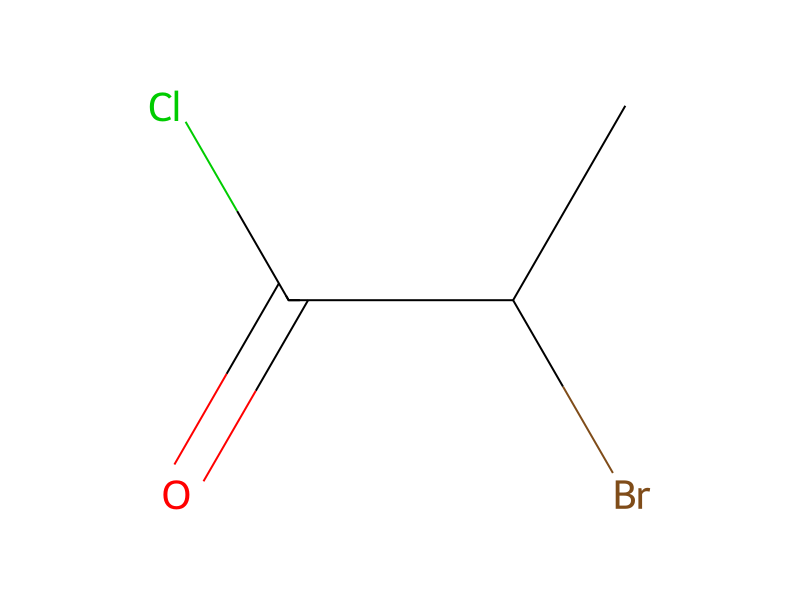

Product 1

Reagents, catalysts & solvents 1

Procedure
The starting material can be synthesized as follows. 3-Carbethoxyamino-10,11-dihydro-5H-dibenz[b,f]azepine (28.2 g, 0.1 moles) is mixed with 300 ml toluene and 20 g (0.11 moles) of 2-bromopropionyl chloride and stirred for 4 hours on a boiling water bath, while HCl gas is escaping. The mixture is allowed to cool to room temperature and filtered and the filtrate is evaporated to dryness under reduced pressure. Upon addition of diethyl ether, the residue crystallizes, after temporarily going into solution. The crystalline deposit is filtered off with suction, washed with ether and dried. 3-Carbethoxyamino-5-(α-bromopropionyl)-10,11-dihydro-5H-dibenz[b,f]azepine (39 g) is obtained, which is purified by recrystallization from the 5-fold amount of isopropanol.
Workup
- customThe starting material can be synthesized
- filtrationfiltered
- customthe filtrate is evaporated to dryness under reduced pressure
- additionUpon addition of diethyl ether
- customthe residue crystallizes
- filtrationThe crystalline deposit is filtered off with suction
- washwashed with ether
- customdried
Sources & evidence
- ORD record
- ord-1196eeed783840a2a77b027fac694526
- Source dataset
- uspto-grants-1993_03
- Patent number
- US05192760
Reaction notes
Loading…