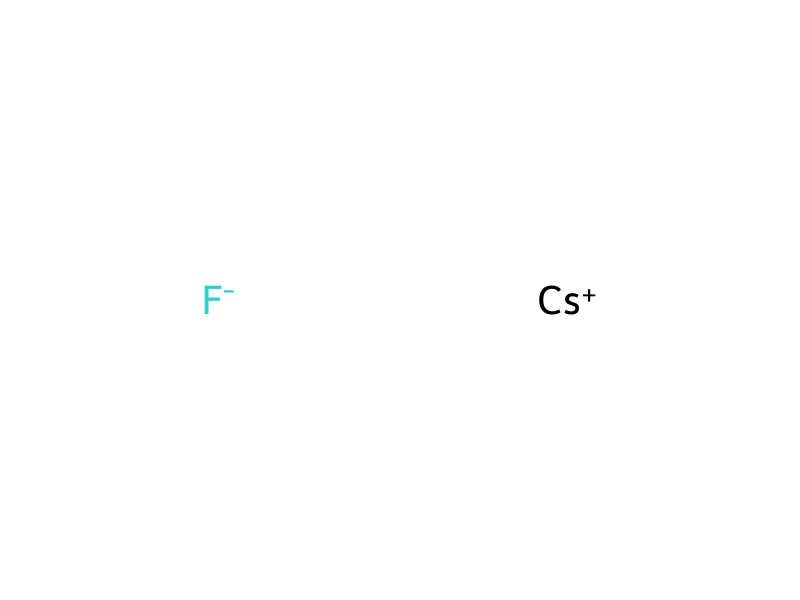
Cesium fluoride → HCID 136200885, compound
Reaction equation

[Cl:1][C:2]1[CH:7]=[C:6]([OH:8])[C:5](I)=[CH:4][C:3]=1[C:10]1[CH:15]=[CH:14][CH:13]=[C:12]([C:16]([F:19])([F:18])[F:17])[CH:11]=1.C([Sn](CCCC)(CCCC)[C:25]1[CH:30]=[CH:29][N:28]=[N:27][CH:26]=1)CCC.[F-].[Cs+]>C(#N)C.[Cu](I)I.C1C=CC(/C=C/C(/C=C/C2C=CC=CC=2)=O)=CC=1.C1C=CC(/C=C/C(/C=C/C2C=CC=CC=2)=O)=CC=1.C1C=CC(/C=C/C(/C=C/C2C=CC=CC=2)=O)=CC=1.[Pd].[Pd]>[Cl:1][C:2]1[CH:7]=[C:6]([OH:8])[C:5]([C:25]2[CH:30]=[CH:29][N:28]=[N:27][CH:26]=2)=[CH:4][C:3]=1[C:10]1[CH:15]=[CH:14][CH:13]=[C:12]([C:16]([F:19])([F:18])[F:17])[CH:11]=1Participants
Reactant 3


Product 1

Reagents, catalysts & solvents 3



Conditions
- Temperature
- 45 °C
Procedure
2-Chloro-5-iodo-3′-(trifluoromethyl)biphenyl-4-ol (Preparation 51, 230 mg, 0.57 mmol) was dissolved in acetonitrile (3 mL), 4-(tributylstannyl)pyridazine (273 mg, 0.75 mmol), caesium fluoride (173 mg, 1.14 mmol), copper iodide (22 mg, 0.114 mmol) and tetrakis(triphenylphosphine)palladium (0) (70 mg, 0.06 mmol) were added. The reaction was stirred at 45° C. for 1.5 hours and then after cooling to room temperature was partitioned between ethyl acetate (100 mL) and water (50 mL) containing 0.880 ammonia (1 mL). The mixture was stirred for 20 minutes. The ethyl acetate phase was separated and washed with an aqueous solution of potassium fluoride (1.5 g in 20 mL), 1M hydrochloric acid (20 mL) and aqueous ammonia (1 mL 0.880 in 50 mL water). The ethyl acetate was dried over MgSO4, filtered and evaporated. The residue was chromatographed on silica eluting with a gradient of dichloromethane:methanol 100:0 to 95:5 to give the title compound (144 mg, 0.40 mmol, 71%) as a white solid.
Workup
- temperatureafter cooling to room temperature
- customwas partitioned between ethyl acetate (100 mL) and water (50 mL)
- additioncontaining 0.880 ammonia (1 mL)
- stirringThe mixture was stirred for 20 minutes
- customThe ethyl acetate phase was separated
- washwashed with an aqueous solution of potassium fluoride (1.5 g in 20 mL), 1M hydrochloric acid (20 mL) and aqueous ammonia (1 mL 0.880 in 50 mL water)
- dry with materialThe ethyl acetate was dried over MgSO4
- filtrationfiltered
- customevaporated
- customThe residue was chromatographed on silica eluting with a gradient of dichloromethane:methanol 100:0 to 95:5
Sources & evidence
- ORD record
- ord-a86daddfbec14267a09ba3f62a433b10
- Source dataset
- uspto-grants-2014_07
- Patent number
- US08772293B2
Reaction notes
Loading…