Acetyl chloride → Thiophene-3-methanol
Reaction equation

C(C1C=CSC=1C1SC=CC=1C1SC=CC=1C1SC=CC=1CCCCCCCCCCCC)CCCCCCCCCCC.BrC(CCCCCCCCCC)CC1SC=CC=1.C1C(=O)N(Br)[C:65](=[O:66])[CH2:64]1.[S:71]1[CH:75]=[CH:74][C:73]([CH2:76][OH:77])=[CH:72]1.C(Cl)(=O)C>C(Cl)(Cl)Cl.C(O)(=O)C.CN(C1C=CN=CC=1)C>[C:65]([O:77][CH2:76][C:73]1[CH:74]=[CH:75][S:71][CH:72]=1)(=[O:66])[CH3:64].[S:71]1[CH:75]=[CH:74][C:73]([CH2:76][OH:77])=[CH:72]1Participants
Reactant 5


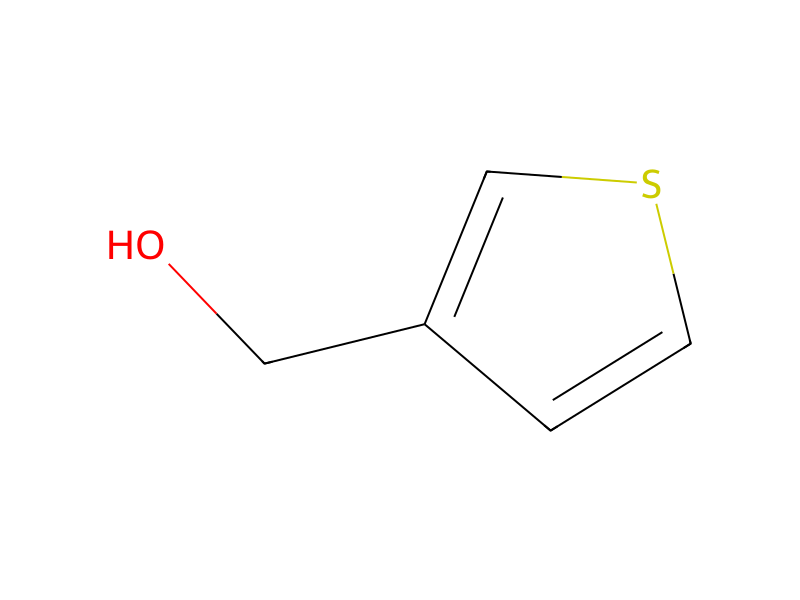


Product 2

Reagents, catalysts & solvents 2


Procedure
The syntheses of the initial hydroxymethyl polymer and O-alkyl derivatives are outlined in Schemes 1 and 2, respectively. The synthesis of the monomer 3,3′″-Didodecylquaterthiophene was obtained as reported in the literature in 75% yield by Stille coupling of two equivalents of 2-bromododecylthiophene with 5,5′-bis(trimethyltin)-2,2′-bithiophene.72 2,2′-Dibromo-3-3′″-didodecyl-quaterthiophene was then subjected to bromination using two equivalents of n-bromosuccinimide (NBS) in chloroform/acetic acid. The product was confirmed by the appearance of a singlet peak at 6.89 ppm in 1H NMR corresponding to the C—H proton at the 2-position of the thiophene ring. Thiophen-3-ylmethyl acetate was synthesized from thiophen-3-ylmethanol, which when subjected to acetylation using acetyl chloride in presence of DMAP as a catalyst resulted in the desired compound in good yield.73 Thien-3-ylmethanol was obtained from the reduction of thiophene-3-carboxaldehyde using LiAlH4. 1H NMR confirmed the product. A functionalized TTF derivative was synthesized by subjecting TTF to monolithiation using lithium diisoproplyamide as reported in the literature. The monolithiated product hence formed was formylated using N-methyl-N-phenylformamide, which then upon reduction with NaBH4 in methanol resulted in 4-formyltetrathiafulvalene.74 4-Formyltetrathiafulvalene was then substituted with 1,8-dibromooctane in a THF/DMF solvent mixture, which resulted in 4-(((8-bromooctyl)oxy)methyl)-2,2′-bi(1,3-dithiolylidene) in 65% yield. The product was confirmed by the disappearance of the —OH peak at 1.9 ppm and the appearance of two different types of triplet at 3.40 ppm and 3.42 ppm.
Workup
- customwas obtained
Sources & evidence
- ORD record
- ord-ea757da1e1664cca8624cfe41824e3a5
- Source dataset
- uspto-grants-2014_07
- Patent number
- US08772764B2
Reaction notes
Loading…