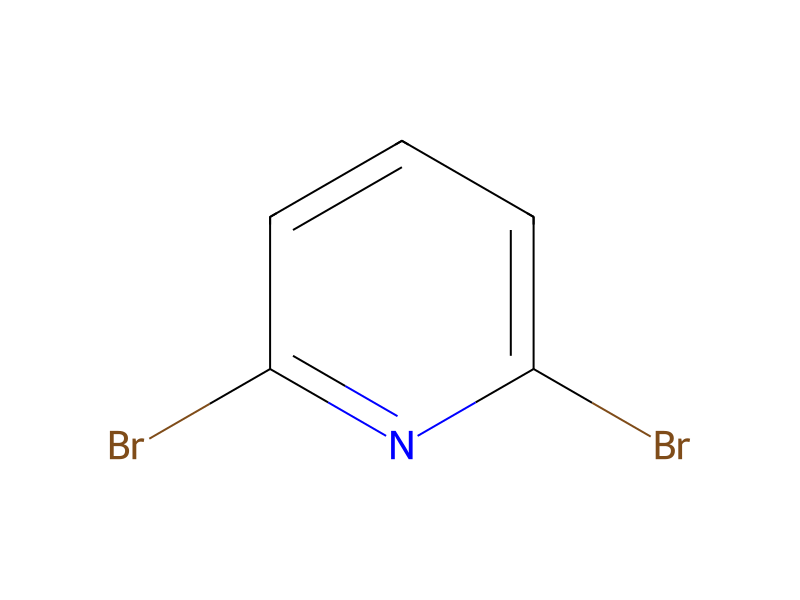
2,6-Dibromopyridine → HCID 86652414, compound
Reaction equation

[Br-].[F:2][C:3]1[CH:10]=[CH:9][CH:8]=[CH:7][C:4]=1[CH2:5][Zn+].[Br:11][C:12]1[CH:17]=[CH:16][CH:15]=[C:14](Br)[N:13]=1>C1C=CC([P]([Pd]([P](C2C=CC=CC=2)(C2C=CC=CC=2)C2C=CC=CC=2)([P](C2C=CC=CC=2)(C2C=CC=CC=2)C2C=CC=CC=2)[P](C2C=CC=CC=2)(C2C=CC=CC=2)C2C=CC=CC=2)(C2C=CC=CC=2)C2C=CC=CC=2)=CC=1>[Br:11][C:12]1[CH:17]=[CH:16][CH:15]=[C:14]([CH2:5][C:4]2[CH:7]=[CH:8][CH:9]=[CH:10][C:3]=2[F:2])[N:13]=1Participants
4
Reactant 2

Product 1

Reagents, catalysts & solvents 1

Conditions
- Temperature
- 68 °C
Procedure
A solution of 2-fluoro-benzylzinc bromide was added to 2,6-dibromo-pyridine (1.25 g, 5.27 mmol) then tetrakis(triphenylphosphine)palladium(0) (0.122 g, 0.106 mmol) was added and the reaction was heated to 68° C. for 4 hours. After cooling, silica gel was added to the reaction and it was concentrated to near-dryness. The silica gel was loaded onto a column of silica gel for purification to afford the title compound.
Workup
- temperatureAfter cooling
- additionsilica gel was added to the reaction and it
- concentrationwas concentrated to near-dryness
- customThe silica gel was loaded onto a column of silica gel for purification
Sources & evidence
- ORD record
- ord-aca037c1101641deb0ebde6550ee638c
- Source dataset
- uspto-grants-2014_07
- Patent number
- US08778983B2
Reaction notes
Loading…