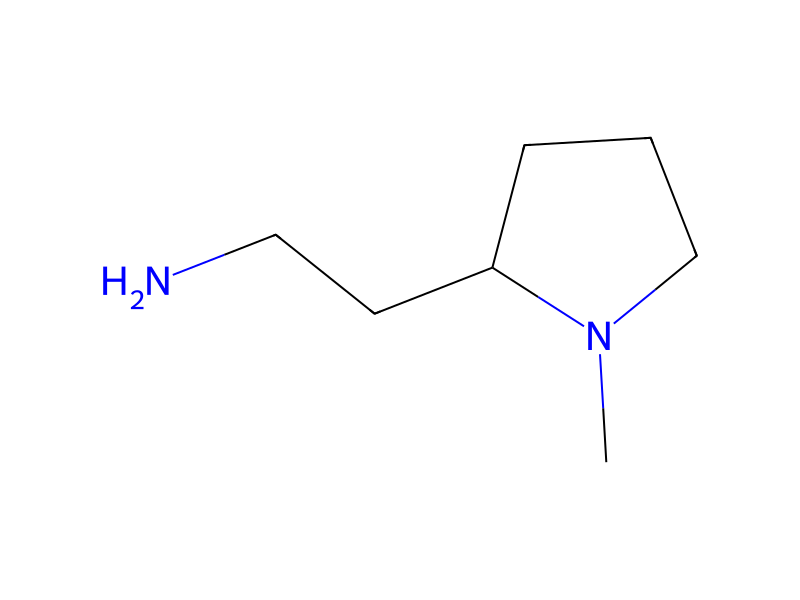
2-(2-Aminoethyl)-1-methylpyrrolidine → 2-(cyclohexylmethyl)-N-{2-[(2S)-1-methylpyrrolidin-2-yl]ethyl}-1,2,3,4-tetrahydroisoquinoline-7-sulfonamide
Reaction equation

F[C:2](F)(F)[C:3]([N:5]1[CH2:14][CH2:13][C:12]2[C:7](=[CH:8][C:9]([S:15](Cl)(=[O:17])=[O:16])=[CH:10][CH:11]=2)[CH2:6]1)=O.[NH2:21][CH2:22][CH2:23][CH:24]1[CH2:28][CH2:27][CH2:26][N:25]1[CH3:29]>CO.Cl>[CH:2]1([CH2:3][N:5]2[CH2:14][CH2:13][C:12]3[C:7](=[CH:8][C:9]([S:15]([NH:21][CH2:22][CH2:23][C@@H:24]4[CH2:28][CH2:27][CH2:26][N:25]4[CH3:29])(=[O:17])=[O:16])=[CH:10][CH:11]=3)[CH2:6]2)[CH2:11][CH2:12][CH2:7][CH2:8][CH2:9]1Participants
Reactant 2

Product 1

Reagents, catalysts & solvents 2


Procedure
WO2005/118547 describes a general method of synthesis which is difficult to transpose to the industrial scale for production in large quantities. This method of synthesis entails reacting 2-(2,2,2-trifluoroacetyl)-1,2,3,4-tetrahydro-isoquinoline-7-sulfonyl chloride with (+/−)-2-(2-aminoethyl)-1-methylpyrrolidine, which product is deprotected in methanol and hydrochloric acid. The enantiomers are next separated by chiral chromatography. The resulting N-{2-[(2S)-1-methylpyrrolidin-2-yl]ethyl}-1,2,3,4-tetrahydroisoquinoline-7-sulfonamide undergoes reductive amination with cyclohexanecarboxaldehyde in the presence of a palladium catalyst. 2-(Cyclohexylmethyl)-N-{2-[(2S)-1-methylpyrrolidin-2-yl]ethyl}-1,2,3,4-tetrahydroisoquinoline-7-sulfonamide is isolated as the free base and converted to a salt.
Workup
- customa general method of synthesis which
- customThis method of synthesis
- customThe enantiomers are next separated by chiral chromatography
Sources & evidence
- ORD record
- ord-8ffc578a4ae74a5ab14c443fbec9c4cf
- Source dataset
- uspto-grants-2014_07
- Patent number
- US08779145B2
Reaction notes
Loading…