Hydrochloric Acid → 58725-39-6
Reaction equation

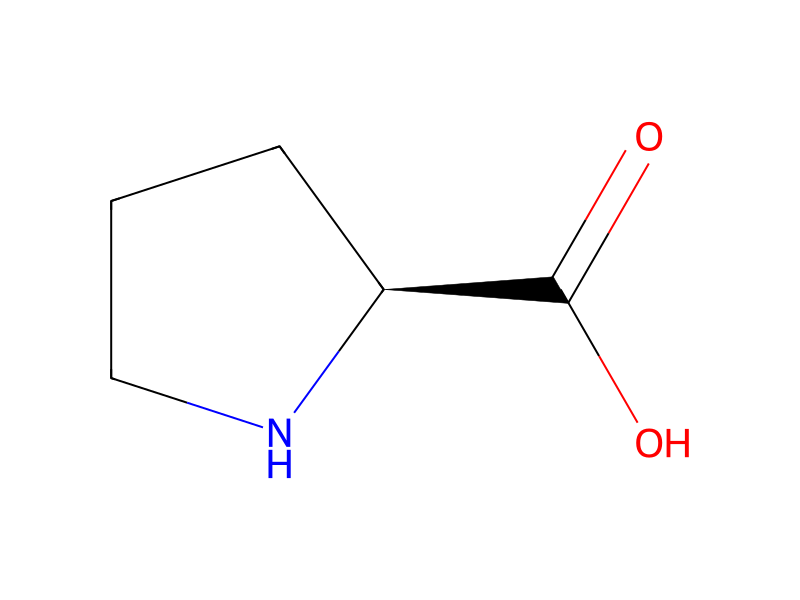
[NH:1]1[CH2:8][CH2:7][CH2:6][C@H:2]1[C:3]([OH:5])=[O:4].[C:9](Cl)(=[O:21])[CH2:10][CH2:11][CH2:12][CH2:13][CH2:14][CH2:15][CH2:16][CH2:17][CH2:18][CH2:19][CH3:20].Cl>[OH-].[Na+]>[C:9]([N:1]1[CH2:8][CH2:7][CH2:6][C@H:2]1[C:3]([OH:5])=[O:4])(=[O:21])[CH2:10][CH2:11][CH2:12][CH2:13][CH2:14][CH2:15][CH2:16][CH2:17][CH2:18][CH2:19][CH3:20]Participants
5
Reactant 3


Product 1

Reagents, catalysts & solvents 1

Procedure
L-proline (11.6 g, 0.1 mol) was dissolved in 150 mL of 1 M NaOH solution and cooled in an ice both. To this solution dodecanoyl chloride (24.1 g or O.11 mol) and 200 mL of 1 M NaOH solution were added simultaneously over a period of 20 min. The solution was stirred at room temperature for 45 min and acidified with concentrated HCl (pH 2-3). The solution was extracted with diethyl ether and the organic phase was washed with 12% NaCl solution. The organic phase was then dried over sodium sulfate and evaporated to provide 30 g of N-dodecanoyl-L-proline as an oil (100% yield) which was carried on without purification.
Workup
- extractionThe solution was extracted with diethyl ether
- washthe organic phase was washed with 12% NaCl solution
- dry with materialThe organic phase was then dried over sodium sulfate
- customevaporated
Sources & evidence
- ORD record
- ord-cf4d72d546fb4a22bceeb209740155ae
- Source dataset
- uspto-grants-2003_01
- Patent number
- US06503398B2
Reaction notes
Loading…