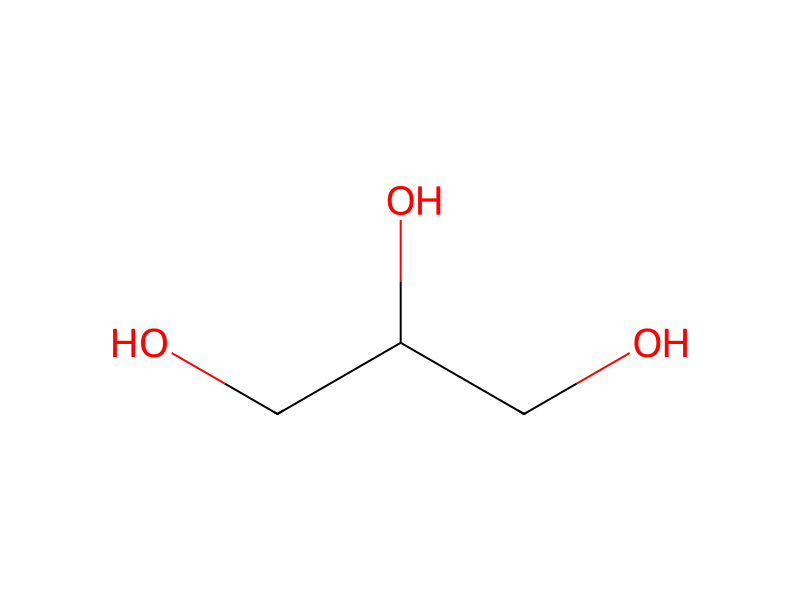
Glycerol → Octadienyl glyceryl ether
Reaction equation

[OH:1][CH2:2][CH:3]([CH2:5][OH:6])[OH:4].O.[CH2:8]=[CH:9][CH:10]=[CH2:11]>CCCCCCCC.C/C(/[O-])=C/C(C)=O.C/C(/[O-])=C/C(C)=O.[Pd+2]>[CH2:2]([O:1][CH:8]=[CH:9][CH:10]=[CH:11][CH2:8][CH2:9][CH2:10][CH3:11])[CH:3]([CH2:5][OH:6])[OH:4]Participants
Reactant 3


Product 1

Reagents, catalysts & solvents 2


Conditions
- Temperature
- 80 °C
Procedure
In a 500-mL autoclave, charged were 70 g (0.76 mol) of glycerin, 0.7 g (2.3 mmol) of bis(acetylacetonato)palladium (II), 2.7 g (5.0 mmol) of triphenylphosphine-2,2′-disulfonic acid dipotassium salt dihydrate and 35 g of water. The mixture was heated to 80° C., whereby a water-soluble liquid phase was obtained. After cooling, a hydrocarbon solvent phase containing 100 g (1.85 mol) of 1,3-butadiene dissolved in 100 g of n-octane was introduced at a time into the autoclave. While stirring, the mixture was heated to 80° C. again. The initial pressure in the autoclave showed 0.9 Mpa. After stirring at 80° C. for 12 hours, the water phase and unreacted butadiene were removed. The residue was washed with water and n-octane was removed, whereby 106 g of octadienyl glyceryl ether was obtained as a pale yellow transparent oil.
Workup
- additionIn a 500-mL autoclave, charged
- temperatureAfter cooling
- additionwas introduced at a time into the autoclave
- temperaturethe mixture was heated to 80° C. again
- stirringAfter stirring at 80° C. for 12 hours
- customthe water phase and unreacted butadiene were removed
- washThe residue was washed with water and n-octane
- customwas removed
Sources & evidence
- ORD record
- ord-35153977a99e4cc3a63809e6cb0b68ae
- Source dataset
- uspto-grants-2003_01
- Patent number
- US06504063B2
Reaction notes
Loading…