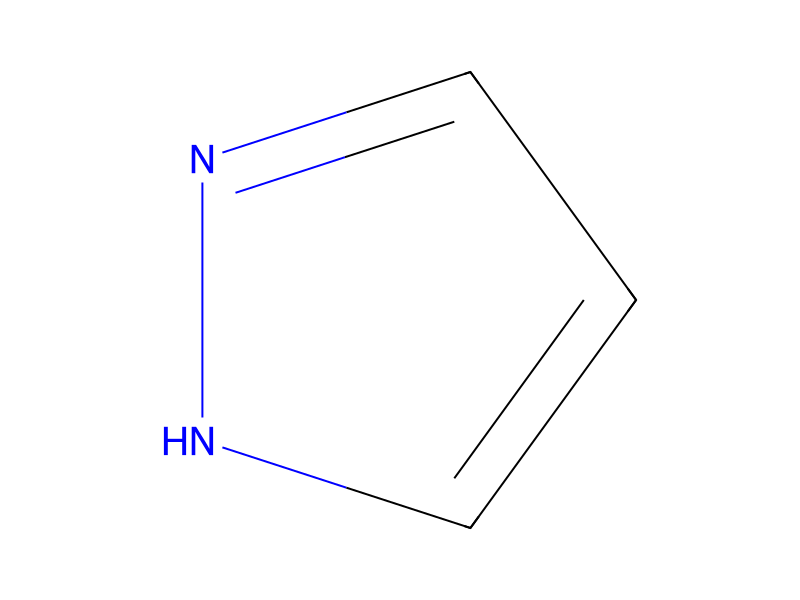
Pyrazole → 2-Chloropyridine-4-carbonyl chloride
Reaction equation

N1C=CC=N1.[Cl:6][C:7]1[CH:12]=[C:11]([C:13]([OH:15])=O)[CH:10]=[CH:9][N:8]=1.S(Cl)([Cl:18])=O>N1C=CC=CC=1.C1(C)C=CC=CC=1>[Cl:6][C:7]1[CH:12]=[C:11]([C:13]([Cl:18])=[O:15])[CH:10]=[CH:9][N:8]=1Participants
Reactant 3


Product 1

Reagents, catalysts & solvents 2


Procedure
Scheme III shows the synthesis of a pyrazole, compound 13, analogs of compound 5 in which the pyridine 10 ring bears a chlorine atom at position 2. 2-Chloropyridine-4-carboxylic acid, compound 9, is treated with thionyl chloride in a solvent such as toluene, and heated to reflux to give 2-chloropyridine-4-carboxylic acid chloride, compound 10, which is then converted to methyl 2-chloroisonicotinate, compound 11. Compound 11 is treated with a ketone 2 in the presence of a base such as sodium methoxide in a solvent such as tetrahydrofuran, at temperatures ranging from 25° C. up to reflux to provide a diketone, compound 12. Treatment of the diketone, compound 12, with an arylhydrazine derivative 4 in ethanol or other suitable solvent at a temperature ranging up to reflux, provides pyrazole compound 13. When R2 of ketone 2 is hydrido, then R2 of 13 is hydrido.
Workup
- temperatureheated
- temperatureto reflux
Sources & evidence
- ORD record
- ord-717e5a9d5ef44157b00136e397e1688c
- Source dataset
- uspto-grants-2003_01
- Patent number
- US06509361B1
Reaction notes
Loading…