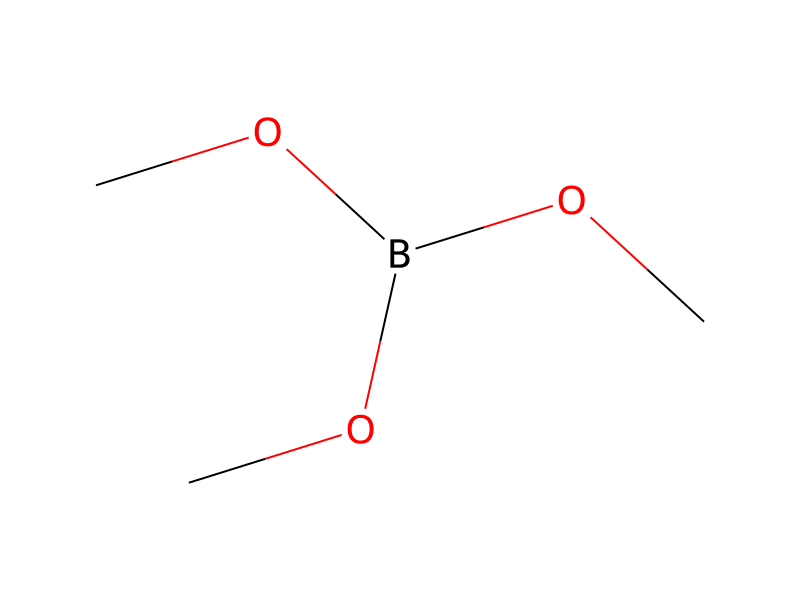
Trimethyl borate → HCID 59883201, compound
Reaction equation

[NH2:1][C@H:2]([CH:17]1[CH2:22][CH2:21][CH2:20][CH2:19][CH2:18]1)[C:3]([C:11]1[CH:16]=[CH:15][CH:14]=[CH:13][CH:12]=1)([C:5]1[CH:10]=[CH:9][CH:8]=[CH:7][CH:6]=1)[OH:4].[CH3:23][O:24][B:25](OC)OC>O1CCCC1>[CH:17]1([C@@H:2]2[C:3]([C:11]3[CH:12]=[CH:13][CH:14]=[CH:15][CH:16]=3)([C:5]3[CH:10]=[CH:9][CH:8]=[CH:7][CH:6]=3)[O:4][B:25]([O:24][CH3:23])[NH:1]2)[CH2:22][CH2:21][CH2:20][CH2:19][CH2:18]1Participants
Reactant 2

Product 1

Reagents, catalysts & solvents 1

Procedure
Dry (R)-2-amino-2-cyclohexyl-1,1-diphenylethanol (147.7 g, 0.5 mmol), dry tetrahydrofuran (2.5 mL) and trimethylborate (68 μL) were added to a dry flask and stirred at room temperature to produce a solution of (R)-4-cyclohexyl-2-methoxy-5,5-diphenyl-1,3,2-oxazaborolidine. 0.5 mL (0.1 mmol) of this solution was added to a borane/dimethylsulfide complex (50 μL, 0.5 mmol) in a dry flask and a solution of (4-chloroacetyl)methane-sulfonanilide (124 mg, 0.5 mmol) in dry tetrahydrofuran (3 mL) was added over 20 minutes via a syringe pump. The reaction was stirred for a further 2 hours, at which time thin layer chromatography (silica gel, hexane/ethyl acetate 1:1) showed that the reduction was complete. The reaction was then quenched by the addition of methanol and concentrated to a solid residue, which was dissolved in ethyl acetate and washed with 2N hydrochloric acid. The ethyl acetate layer was separated, dried over magnesium sulfate and concentrated to give (R)-4-(1-hydroxy-2-chloroethyl)methanesulfonanilide. The enantiomeric excess=94.3% (R), as measured by chiral HPLC (Chiralcel OD-H column, mobile phase, hexane/ethyl acetate (7:3, flow rate=0.7 mL/min).
Sources & evidence
- ORD record
- ord-1526078d501b41799144d08755e20b57
- Source dataset
- uspto-grants-2003_01
- Patent number
- US06509472B2
Reaction notes
Loading…