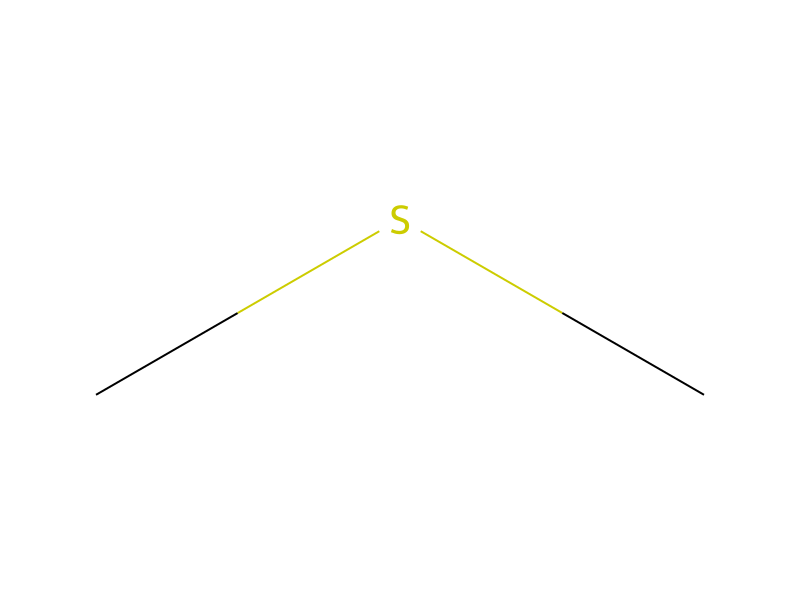
Dimethyl Sulfide → 2-[2-(4-Chlorophenoxy)propan-2-yl]-2-(4-chlorophenyl)oxirane
Reaction equation

S(OC)(O[CH3:5])(=O)=O.CSC.[Cl:11][C:12]1[CH:30]=[CH:29][C:15]([O:16][C:17]([C:20]([C:22]2[CH:27]=[CH:26][C:25]([Cl:28])=[CH:24][CH:23]=2)=[O:21])([CH3:19])[CH3:18])=[CH:14][CH:13]=1.C[O-].[Na+]>C(#N)C>[Cl:28][C:25]1[CH:26]=[CH:27][C:22]([C:20]2([C:17]([O:16][C:15]3[CH:14]=[CH:13][C:12]([Cl:11])=[CH:30][CH:29]=3)([CH3:19])[CH3:18])[CH2:5][O:21]2)=[CH:23][CH:24]=1Participants
Reactant 4



Product 1

Reagents, catalysts & solvents 1

Procedure
A solution of 59.2 g (0.47 mol) of dimethyl sulphate and 32 g (0.517 mol) of dimethyl sulphide in 270 ml of acetonitrile is stirred at room temperature for 5 days. A solution of 87 g of 4-chlorophenyl 2-(p-chlorophenoxy)-prop-2-yl ketone in 80 ml of acetonitrile is then added dropwise at 20° to 25° C., in the course of approx. 2 hours. 28.7 g (0.53 mol) of sodium methylate are introduced at the same temperature, and the mixture is stirred for a further 12 hours and then concentrated. The residue is stirred overnight with a mixture of 200 ml of ethyl acetate and 150 ml of water. The organic phase is separated off, dried over sodium sulphate and concentrated in vacuo. 49 g (76% of theory) of crude 2-(4 chlorophenyl)-2-[2-(p-chlorophenoxy)-prop-2-yl]-oxirane are obtained, and this compound is directly reacted further. ##STR158## 52 g (0.3982 mol) of p-chlorophenol and 55 g (0.3982 mol) of potassium carbonate in 400 ml of toluene are heated under reflux for 2 hours in a water separator. The mixture is cooled to 40° C., and a solution of 2-bromo-prop-2-yl 4-chlorophenyl ketone in 170 ml of toluene is added dropwise. This reaction mixture is stirred for a further 5 hours at 100° C. and then cooled, water is added and the organic phase is separated off. This is washed with dilute sodium hydroxide solution and water, dried over sodium sulphate and concentrated. 87 g (85% of theory) of crude 4-chlorophenyl 2-(p-chlorophenoxy)-prop-2-yl ketone are obtained, and this compound is directly reacted further. ##STR159## 1 ml of hydrogen bromide/glacial acetic acid is added to 65.5 g (0.36 mol) of 4-chlorophenyl isopropyl ketone in 200 ml of chloroform, and 57.5 g (0.36 mol) of bromine are then added dropwise at 30° C. The mixture is stirred for a further 30 minutes at room temperature, and thereafter concentrated in vacuo. 86.6 g (92% of theory) of crude 2-bromo-prop-2-yl 4-chlorophenyl ketone are obtained, and this compound is directly reacted further.
Workup
- concentrationconcentrated
- stirringThe residue is stirred overnight with a mixture of 200 ml of ethyl acetate and 150 ml of water
- customThe organic phase is separated off
- dry with materialdried over sodium sulphate
- concentrationconcentrated in vacuo
Sources & evidence
- ORD record
- ord-ec97c6d869fc416d8f707c2fca52beae
- Source dataset
- uspto-grants-1989_11
- Patent number
- US04879385
Reaction notes
Loading…