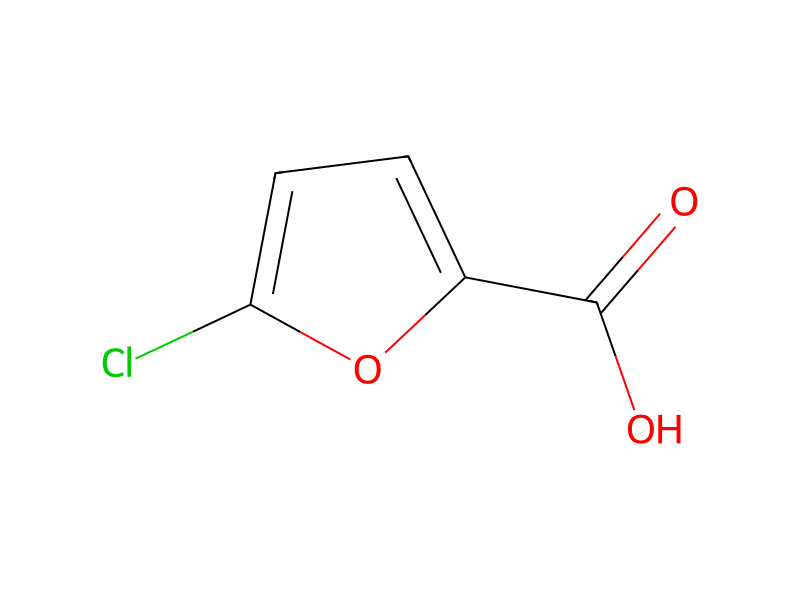
Sodium Hydroxide → 5-Chlorofuran-2-carboxylic acid
Reaction equation

[OH-:1].[Na+].[OH-].[NH4+].[Cl:5][C:6]1[O:10][C:9]([CH:11]=[O:12])=[CH:8][CH:7]=1>O.CO.[N+]([O-])([O-])=O.[Ag+]>[Cl:5][C:6]1[O:10][C:9]([C:11]([OH:1])=[O:12])=[CH:8][CH:7]=1Participants






Procedure
Aqueous sodium hydroxide (80 mL of 10%) was added to a solution of silver nitrate (8.0 g, 47 mmol) in water (20 mL). This suspension was stirred and slowly treated with 30% aqueous ammonium hydroxide until it became clear. A solution of 5-chlorofuran-2-carboxaldehyde (3.0 g, 23 mmol) (Aldrich Chemical) in methanol (5 mL) was added, and the resulting mixture was stirred at ambient temperature for 30 min. The reaction mixture was filtered, and the filtrate was washed with ether (100 mL). The aqueous filtrate was then made acidic (˜pH 3) by the addition of cold 20% sulfuric acid. The resulting mixture was extracted with ethyl acetate (3×100 mL). The extracts were washed with saturated aqueous sodium chloride solution (100 mL), dried (anhydrous sodium sulfate) and concentrated under vacuum to give 3.2 g (95% yield) of white solid (mp 178-179° C.). This reaction was easily scalable and was run multiple times at >10 g scale.
Workup
- stirringthe resulting mixture was stirred at ambient temperature for 30 min
- filtrationThe reaction mixture was filtered
- washthe filtrate was washed with ether (100 mL)
- additionmade acidic (˜pH 3) by the addition of cold 20% sulfuric acid
- extractionThe resulting mixture was extracted with ethyl acetate (3×100 mL)
- washThe extracts were washed with saturated aqueous sodium chloride solution (100 mL)
- dry with materialdried (anhydrous sodium sulfate)
- concentrationconcentrated under vacuum
Sources & evidence
- ORD record
- ord-7bb5b152286b49b692cba3d505597bd6
- Source dataset
- uspto-grants-2012_02
- Patent number
- US08114889B2
Reaction notes
Loading…