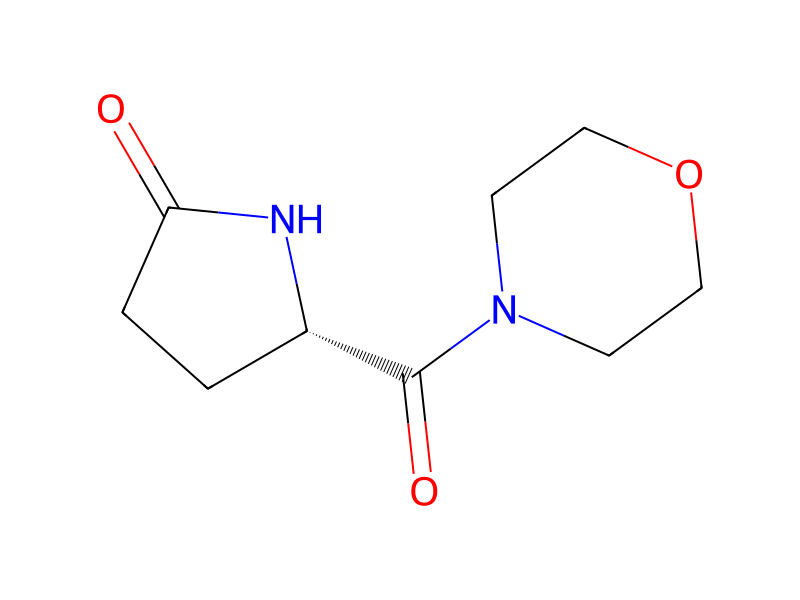
Morpholine → (S)-4-((5-Oxo-2-pyrrolidinyl)carbonyl)morpholine
Reaction equation

CO[C:3](=[O:10])[C@@H:4]1[CH2:8][CH2:7][C:6](=[O:9])[NH:5]1.[NH:11]1[CH2:16][CH2:15][O:14][CH2:13][CH2:12]1>CN(C)C1C=CN=CC=1.C1(C)C=CC=CC=1>[N:11]1([C:3]([C@H:4]2[NH:5][C:6](=[O:9])[CH2:7][CH2:8]2)=[O:10])[CH2:16][CH2:15][O:14][CH2:13][CH2:12]1Participants
5
Reactant 2


Product 1
Reagents, catalysts & solvents 2


Procedure
L-pyroglutamic acid methyl ester (23.91 g, 177 mmol), morpholine (21.8 g, 250 mmol) and 4-dimethylaminopyridine (0.2 g, 1.64 mmol) are heated under reflux in toluene (130 ml) for 12 hours. The product precipitates as an oil. The oil is separated from the toluene, diluted with dichloromethane (100 ml) and washed successively with 0.1 M HCl, 0.1 M NaOH and water (50 ml each). The dichloromethane phase is concentrated to obtain a suspension, which is filtered yielding the crude product. The crude product is dissolved in THF (200 ml) at 45° C. and, upon cooling in an ice bath, (S)-5-morpholine-4-carbonyl)pyrrolidin-2-one precipitates as white crystals. Enantiopurity (GC) 88.7% (S)-Enantiomer.
Workup
- customThe product precipitates as an oil
- customThe oil is separated from the toluene
- additiondiluted with dichloromethane (100 ml)
- washwashed successively with 0.1 M HCl, 0.1 M NaOH and water (50 ml each)
- concentrationThe dichloromethane phase is concentrated
- customto obtain a suspension, which
- filtrationis filtered
Sources & evidence
- ORD record
- ord-6fc290d6101b46ce8bcc643c7a4c1a12
- Source dataset
- uspto-grants-2012_02
- Patent number
- US08115016B2
Reaction notes
Loading…