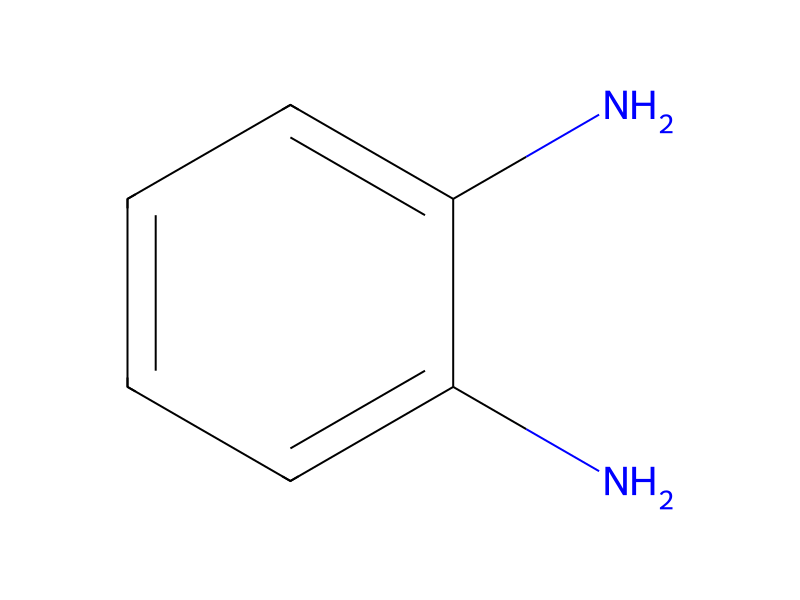
O-Phenylenediamine → 2-(4-Bromophenyl)-3-phenylquinoxaline
Reaction equation

[Br:1][C:2]1[CH:7]=[CH:6][C:5]([C:8](=O)[C:9]([C:11]2[CH:16]=[CH:15][CH:14]=[CH:13][CH:12]=2)=O)=[CH:4][CH:3]=1.[C:18]1([NH2:25])[CH:23]=[CH:22][CH:21]=[CH:20][C:19]=1[NH2:24]>C(O)C>[Br:1][C:2]1[CH:7]=[CH:6][C:5]([C:8]2[C:9]([C:11]3[CH:16]=[CH:15][CH:14]=[CH:13][CH:12]=3)=[N:25][C:18]3[C:19](=[CH:20][CH:21]=[CH:22][CH:23]=3)[N:24]=2)=[CH:4][CH:3]=1Participants
4
Reactant 2

Product 1

Reagents, catalysts & solvents 1

Procedure
In a 200 mL recovery flask were placed 4.5 g (15 mmol) of 1-(4-bromophenyl)-2-phenylethanedione, 1.8 g (17 mmol) of 1,2-phenylenediamine, and 50 mL of ethanol. This solution was refluxed under nitrogen stream for 2.5 hours. After a predetermined time, the solution was cooled to room temperature, and the precipitated solid was collected by suction filtration. The collected solid was washed with ethanol, so that 5.2 g of target white powder was obtained with a yield of 92%.
Workup
- customIn a 200 mL recovery flask were placed
- temperatureThis solution was refluxed under nitrogen stream for 2.5 hours
- filtrationthe precipitated solid was collected by suction filtration
- washThe collected solid was washed with ethanol, so that 5.2 g of target white powder
- customwas obtained with a yield of 92%
Sources & evidence
- ORD record
- ord-26f53eccf1874b5db86c7fdef6f50ce4
- Source dataset
- uspto-grants-2012_02
- Patent number
- US08119259B2
Reaction notes
Loading…