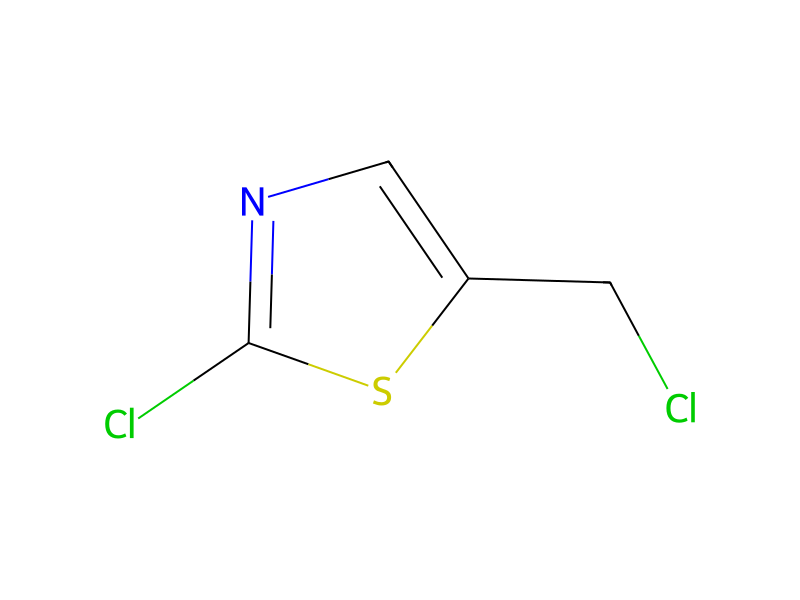
2-Chloro-5-chloromethylthiazole → 2-[(2-Chloro-1,3-thiazol-5-yl)methyl]-1H-isoindole-1,3(2H)-dione
Reaction equation

[C:1]1(=[O:11])[NH:5][C:4](=[O:6])[C:3]2=[CH:7][CH:8]=[CH:9][CH:10]=[C:2]12.[K].[Cl:13][C:14]1[S:15][C:16]([CH2:19]Cl)=[CH:17][N:18]=1>CN(C=O)C>[Cl:13][C:14]1[S:15][C:16]([CH2:19][N:5]2[C:1](=[O:11])[C:2]3=[CH:10][CH:9]=[CH:8][CH:7]=[C:3]3[C:4]2=[O:6])=[CH:17][N:18]=1Participants
Reactant 2

Product 1

Reagents, catalysts & solvents 1

Procedure
To a mixture of potassium phthalimide (10.4 g) and dry DMF (100 ml) was dropwise added a solution of 2-chloro-5-(chloromethyl)thiazole (9.0 g) obtained in the same manner as in Example 2, in 10 ml of DMF in an oil bath at 20° C. over 15 min. After completion of the addition stirring was continued at 60° C. for 45 min. followed by separation of insoluble materials by filtration on celite. The filtrate was concentrated under reduced pressure. To the residue was added 100 ml of dichloromethane again followed by separation of insoluble materials by filtration and concentration of the filtrate. The residue was purified by column chromatography (eluted with dichloromethane-ethyl acetate 20:1) to give 12.0 g of N-(2-chloro-5-thiazolylmethyl)phthalimide, mp 108°-109° C.
Workup
- additionAfter completion of the addition
- customfollowed by separation of insoluble materials by filtration on celite
- concentrationThe filtrate was concentrated under reduced pressure
- additionTo the residue was added 100 ml of dichloromethane
- customagain followed by separation of insoluble materials by filtration and concentration of the filtrate
- customThe residue was purified by column chromatography (eluted with dichloromethane-ethyl acetate 20:1)
Sources & evidence
- ORD record
- ord-9923c2a6f828421ca3dcee6a32a3657d
- Source dataset
- uspto-grants-1993_01
- Patent number
- US05180833
Reaction notes
Loading…