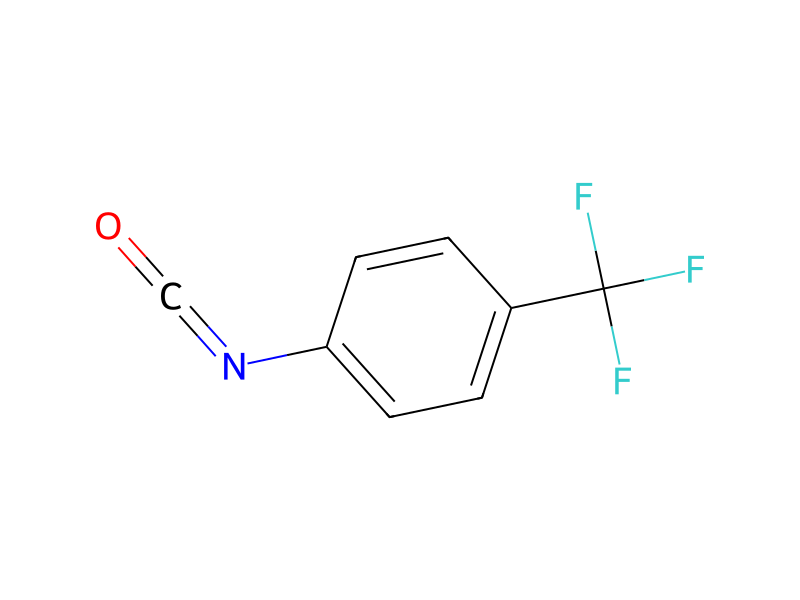
4-(Trifluoromethyl)phenyl isocyanate → HCID 19927549, compound
Reaction equation

[Cl:1][C:2]1[CH:26]=[CH:25][C:5]2/[C:6](=[N:10]/[NH:11][C:12]([NH:14][C:15]3[CH:20]=[CH:19][C:18]([C:21]([F:24])([F:23])[F:22])=[CH:17][CH:16]=3)=[O:13])/[CH:7]([CH3:9])[O:8][C:4]=2[CH:3]=1.FC(F)(F)C1C=CC(N=C=O)=CC=1>>[Cl:1][C:2]1[CH:26]=[CH:25][C:5]2/[C:6](=[N:10]\[NH:11][C:12]([NH:14][C:15]3[CH:16]=[CH:17][C:18]([C:21]([F:23])([F:22])[F:24])=[CH:19][CH:20]=3)=[O:13])/[CH:7]([CH3:9])[O:8][C:4]=2[CH:3]=1Participants
3


Procedure
Treating the anti hydrazone (0.5 g) obtained in Step C with p-trifluoromethylphenylisocyanate (0.4 ml) in the same manner as in Step C resulted in the isolation of the desired product as a solid (0.8 g). m.p.=205°-207° C. NMR: (10.4 (br, NH), 9.4 (br, 1H), 8.2-7.0 (m, 7H), 5.8 (m, 1H), 1.47 (d, 3H).
Sources & evidence
- ORD record
- ord-aaff71ba806c4c17a1ed79f7e51395c5
- Source dataset
- uspto-grants-1993_01
- Patent number
- US05182303
Reaction notes
Loading…