Nitric Acid → (2-Aminophenyl)boronic acid
Reaction equation

[C:1]1([B:7]([OH:9])[OH:8])[CH:6]=[CH:5][CH:4]=[CH:3][CH:2]=1.[N+:10]([O-])(O)=O>C(OC(=O)C)(=O)C>[NH2:10][C:2]1[CH:3]=[CH:4][CH:5]=[CH:6][C:1]=1[B:7]([OH:9])[OH:8]Participants
Reactant 2


Product 1
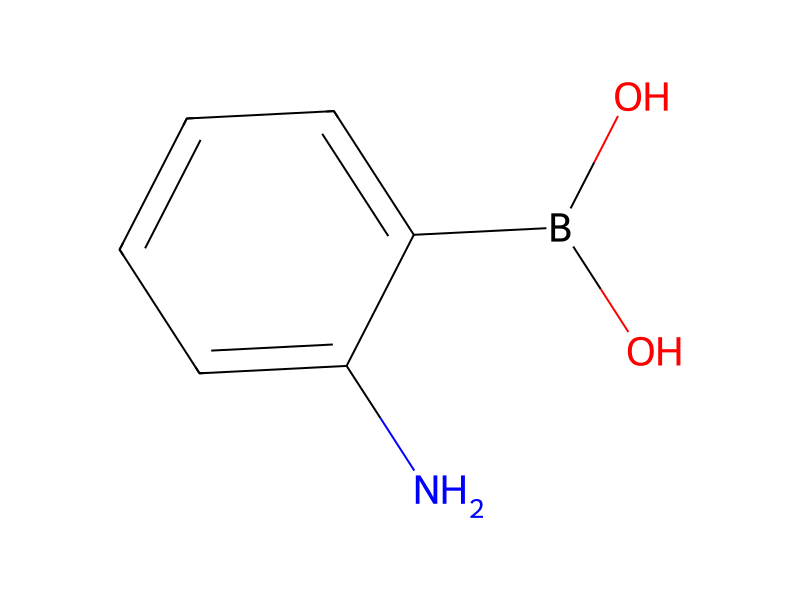
Reagents, catalysts & solvents 1

Procedure
To a three necked round bottom flask equipped with an addition funnel (and argon inlet), thermometer and septum is added phenylboronic acid (40.13 g, 0.33 moles). Acetic anhydride (400 ml) is charged through the septum via syringe. Using a stir bar the mixture is then stirred under argon until the temperature reaches 0° C. with external cooling (ice bath). Fuming nitric acid (25.01 g, 0.397 moles) is added slowly over the course of thirty minutes. The reaction is then allowed to stir an additional two hours at 0° C., before removing the ice bath and allowing the reaction to warm to room temperature. The reaction is poured into ice water (1 L) at which point it appears cloudy. After stirring overnight, however, it becomes homogeneous. The solution is paced on a rotary evaporator at 40° C. under a 5 mm vacuum. When the volume is reduced by about 50%, enough water is added to bring the volume back to 100%. This process is repeated twice more, before bringing the volume to about 300 ml on the rotary evaporator when a precipitate is noticed. Twenty hours are allowed for complete crystallization, and the solids (p-nitrobenzeneboronic acid, 3.66 g) are removed by filtration. Enough water is then added to the filtrate to bring the total volume to 800 mi. The volume is reduced once more under reduced pressure to about 150 ml when a precipitate begins to form. The solids (o-nitrophenylboronic acid, 48.04 g) are collected by filtration and dried in a vacuum oven. To a pressure vessel is added o-nitrophenylboronic acid (31.64 g), 10% palladium on carbon (6.3 g) and ethanol (100 ml). The vessel is shook at room temperature under 50 psi hydrogen on a PARR shaker. After four hours the catalyst is removed by filtration, and the filtrate taken to dryness under reduced pressure. The solids (o-aminophenylboronic acid, 24.4 g) are dried under vacuum for 18 hours.
Workup
- customTo a three necked round bottom flask equipped with an addition funnel (and argon inlet), thermometer and septum
- customreaches 0° C.
- temperaturewith external cooling (ice bath)
- stirringto stir an additional two hours at 0° C.
- custombefore removing the ice bath
- customthe reaction
- stirringAfter stirring overnight
- customThe solution is paced on a rotary evaporator at 40° C. under a 5 mm vacuum
- additionis added
- customon the rotary evaporator when a precipitate
- customTwenty hours are allowed for complete crystallization
- customthe solids (p-nitrobenzeneboronic acid, 3.66 g) are removed by filtration
- additionEnough water is then added to the filtrate
- customto form
- filtrationThe solids (o-nitrophenylboronic acid, 48.04 g) are collected by filtration
- customdried in a vacuum oven
- additionTo a pressure vessel is added o-nitrophenylboronic acid (31.64 g), 10% palladium on carbon (6.3 g) and ethanol (100 ml)
- stirringThe vessel is shook at room temperature under 50 psi hydrogen on a PARR shaker
- customAfter four hours the catalyst is removed by filtration
- dry with materialThe solids (o-aminophenylboronic acid, 24.4 g) are dried under vacuum for 18 hours
Sources & evidence
- ORD record
- ord-480fdc221d4e4317bf504270a1f10b6f
- Source dataset
- uspto-grants-1995_07
- Patent number
- US05431842
Reaction notes
Loading…