2-Isopropylphenol → Bis(2-isopropylphenyl) chlorothiophosphate
Reaction equation
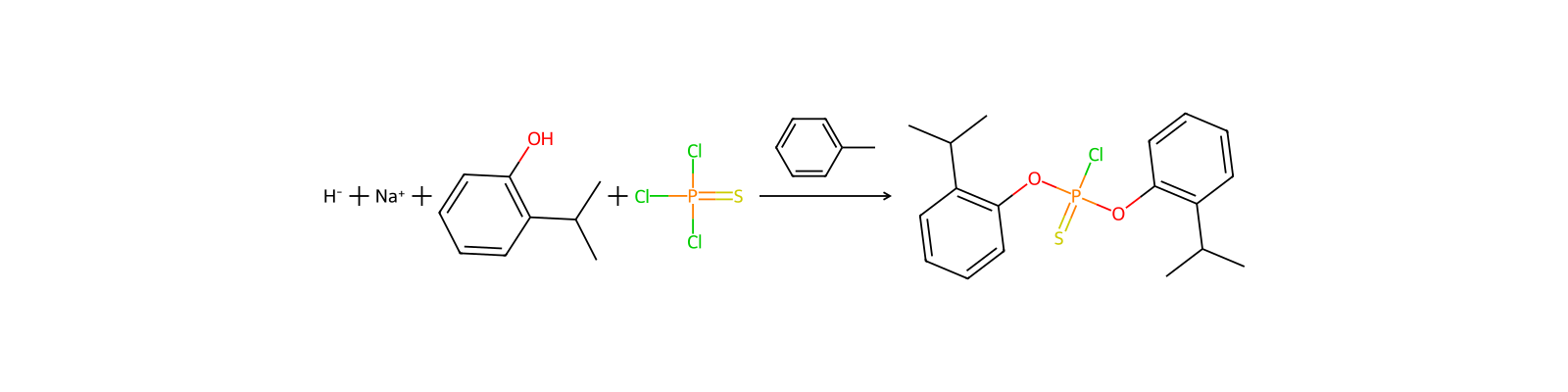
[H-].[Na+].[CH:3]([C:6]1[CH:11]=[CH:10][CH:9]=[CH:8][C:7]=1[OH:12])([CH3:5])[CH3:4].[P:13]([Cl:17])(Cl)(Cl)=[S:14]>C1(C)C=CC=CC=1>[P:13]([Cl:17])([O:12][C:7]1[CH:8]=[CH:9][CH:10]=[CH:11][C:6]=1[CH:3]([CH3:5])[CH3:4])([O:12][C:7]1[CH:8]=[CH:9][CH:10]=[CH:11][C:6]=1[CH:3]([CH3:5])[CH3:4])=[S:14]Participants
Reactant 3
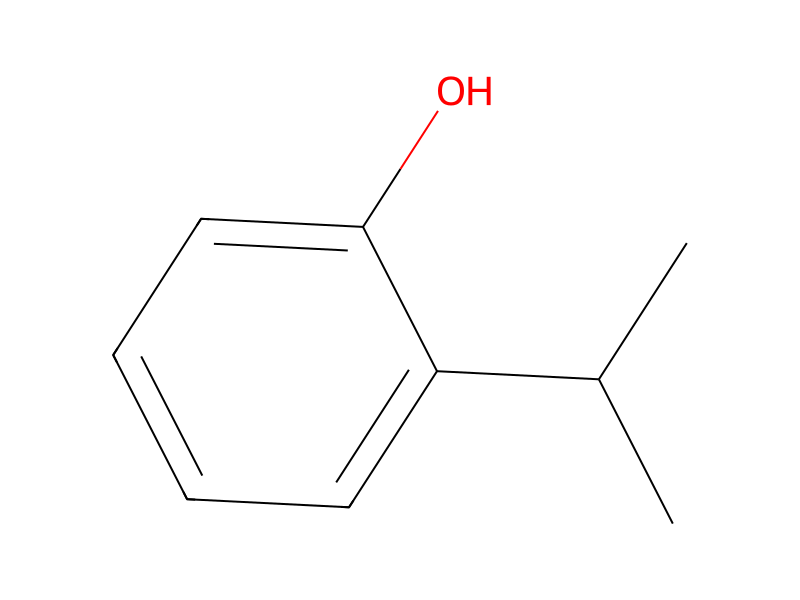


Product 1

Reagents, catalysts & solvents 1

Procedure
Sodium hydride (38.0 g of 80% suspension in mineral oil) was added to a stirred solution of 2-isopropylphenol (139.2 g) and thiophosphoryl chloride (84.5 g) in toluene (500 cm3) at such a rate that the reaction temperature did not rise above 65° C. After stirring for a further 0.5 hr at ambient temperature, the solution was extracted twice with water (250 cm3 portions). separated, dried (MgSO4) and concentrated by distillation of solvents under reduced pressure yielding crude bis(2-isopropylphenyl) chlorothiophosphate, a brown oil (164.2 g); 51P NMR in CDCl3, singlet 53.0 ppm downfield of H3PO4). Of this material, 54.0 g were reacted with ammonia by the procedure of Example 9 yielding crude bis(2-isopropylphenyl)thiophosphoramide) (50.0 g; 31 pNmr, singlet δ=58.8 ppm).
Workup
- customdid not rise above 65° C
- extractionthe solution was extracted twice with water (250 cm3 portions)
- customseparated
- dry with materialdried (MgSO4)
- concentrationconcentrated by distillation of solvents under reduced pressure
Sources & evidence
- ORD record
- ord-05c11efbf35e4df8b369c39fb2b8f48a
- Source dataset
- uspto-grants-1995_07
- Patent number
- US05433855
Reaction notes
Loading…