2-Methyl-6-nitroaniline → 2,3-Diaminotoluene
Reaction equation

[CH3:1][C:2]1[CH:8]=[CH:7][CH:6]=[C:5]([N+:9]([O-])=O)[C:3]=1[NH2:4]>[Pd]>[CH3:1][C:2]1[CH:8]=[CH:7][CH:6]=[C:5]([NH2:9])[C:3]=1[NH2:4]Participants
Reactant 1
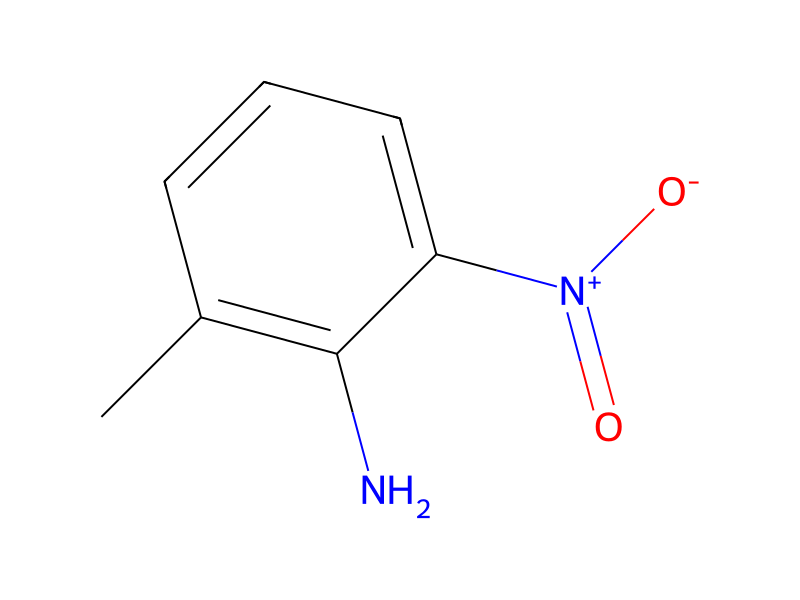
Product 1

Reagents, catalysts & solvents 1

Procedure
The 5,6-dihydro-N,N-dipropyl-4H-imidazo(4,5, 1-ij)quinolin-5-amines of the invention, compounds of Formula I where D is nitrogen, A is CH, n is 0 and D and A are joined by a double bond, may be prepared as illustrated in Scheme 2 for the preparation of compound 6. Catalytic hydrogenation of 2-methyl-6-nitroaniline (XVI) using a palladium catalyst afforded 3-methyl-1,2-benzenediamine (XVII) which was heated with formic acid to give 4-methylbenzimidazole (XVIII). This was heated in dioxane with di-t-butyl dicarbonate and the t-butyl 4-methylbenzimidazole-l-carboxylate (XIXa, R is OC(CH3)3) thus obtained was brominated with N-bromosuccinimide in carbon tetrachloride to give t-butyl 4-(bromomethyl)benzimidazole-1-carboxylate (XXa). Alkylation of XXa with the potassium salt of diethyl (dipropylamino)malonate (VIb) in refluxing THF afforded XXIa which was hydrolyzed to XXII using sodium ethoxide in ethanol containing limited amounts of water. Compound XXII was reduced to the alcohol XXIII using lithium aluminum hydride. When XXIII was treated with carbon tetrabromide and triphenylphosphine in methylene chloride compound 6 was obtained directly. Modifications may be made in this reaction sequence. The hydrolysis of XXIa to XXII may be carried out in two steps; under mild hydrolysis conditions, ethyl-α-(dipropylamino)-1H-benzimidazol-4-propanoate, formed by loss of the t-butoxycarbonyl group, can be obtained as the only reaction product, and this may be subsequently hydrolyzed to XXII. Compound XVIII was reacted with methyl chloroformate to give XIXb (R is OCH3) which was converted in high yield to XXII as shown in Scheme 2. Acetylation of XVIII gave XIXc (R is CH3) which was also converted to XXII, although the yield in this reaction was not as high as when the t-butoxycarbonyl or carbomethoxy protecting groups were used. The reaction sequence of Scheme 2 may be used to prepare analogues in which the dipropylamine substituent is modified. Using the malonates VIi-VIq in place of diethyl (dipropylamino)malonate (VIb), compounds 7-12 were obtained. In the preparation of these compounds the adduct formed by reacting the malonate with XXa was converted to the methyl α-(substituted amino)-1H-benzimidazole-4-propanoate by hydrogenolysis as described in Example 19.
Workup
- custommay be prepared
Sources & evidence
- ORD record
- ord-dd379b3294b243bb8384959698d7e1ae
- Source dataset
- uspto-grants-1995_07
- Patent number
- US05436240
Reaction notes
Loading…