Acetonitrile → (1-Aminoethylidene)bisphosphonic acid
Reaction equation

C([O-])(=O)C.[NH4+].[C:6](#[N:8])[CH3:7].O1P2[O:15][P:16]3[O:18]P(O2)OP1[O:17]3>C(O)C.O.C(O)(=O)C.C(#N)C.C(O)(=O)C>[NH2:8][C:6]([P:16]([OH:15])(=[O:17])[OH:18])([P:16]([OH:18])(=[O:15])[OH:17])[CH3:7]Participants
Reactant 3



Product 1

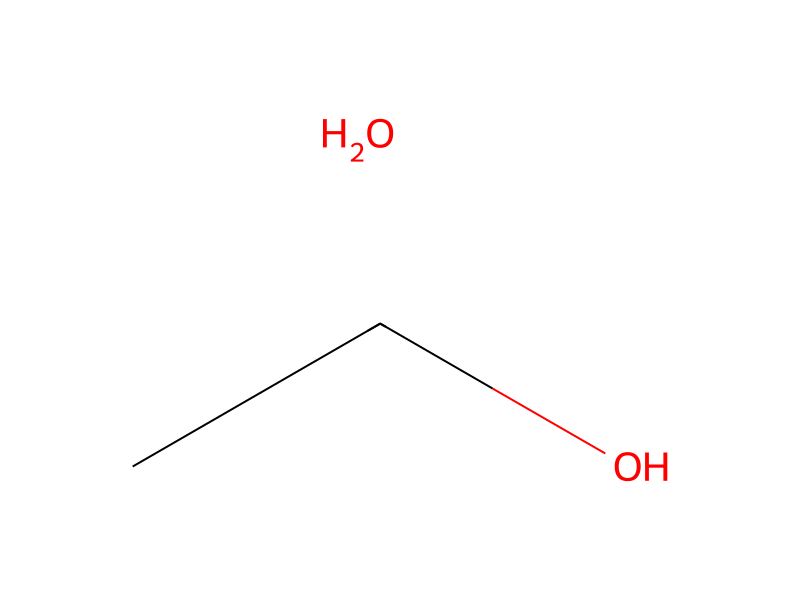
Reagents, catalysts & solvents 3


Conditions
- Temperature
- 80 °C
Procedure
48.8 g (0.63 mol) ammonium acetate was suspended in 68 g (1.66 mols) acetonitrile in a flask which was scavenged with nitrogen, provided with an agitator and had a fractionating column mounted thereon, and the suspension was heated to about 80° C. under reflux. Next, 46.4 g (0.21 mol) molten P4O6 was added dropwise to the boiling mixture, the temperature being maintained at 80°-90° C. While the temperature was gradually increased to 160° C., 85.1 g distillate containing 91.5% acetonitrile and 8.2% acetic acid, corresponding to 77.9 g (0.190 mol)acetonitrile and 7.0 g (0.24 mol) acetic acid, was removed through a short column at a head temperature of 84°-89° C. After deduction of the acetonitrile feed material, 11.9 g (0.24 mol) acetonitrile was found to have been obtained as by-product. The acetonitrile/acetic acid mixture was recycled, after conversion of the acetic acid to ammonium acetate. The colorless residue retained in the flask was boiled for a short while in an ethanol/water-mixture (4:1) and 57.1 g 1-aminoethane-1,1-diphosphonic acid was obtained in a yield of 66%.
Workup
- customprovided with an agitator
- temperatureunder reflux
- temperaturethe temperature being maintained at 80°-90° C
- temperatureWhile the temperature was gradually increased to 160° C.
- customto have been obtained as by-product
Sources & evidence
- ORD record
- ord-a650c02164664daea9ed38d6a5396c37
- Source dataset
- uspto-grants-1983_11
- Patent number
- US04418019
Reaction notes
Loading…