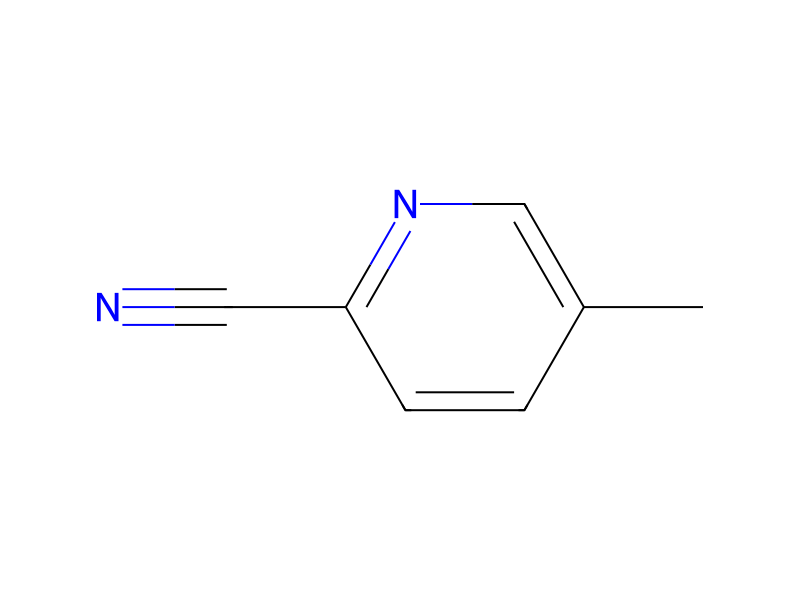
2-Chloroacrylonitrile → 5-Methylpicolinonitrile
Reaction equation

ClC(=C)C#[N:4].[N:6]1([CH:14]2[CH2:21]CC[CH2:18][CH2:17][CH2:16][CH2:15]2)[CH2:13]CCCCCN1>C(#N)C>[C:21]([C:14]1[CH:15]=[CH:16][C:17]([CH3:18])=[CH:13][N:6]=1)#[N:4]Participants
4
Reactant 2


Product 1
Reagents, catalysts & solvents 1

Procedure
19.6 g of 1-dimethyl-1-aza-3-methyl-1,3-butadiene, 17.5 g of 2-chloroacrylonitrile and 33.6 g of diazabicyclooctane (DABCO) are heated in 200 ml of acetonitrile for 30 hours to reflux. The reaction mixture is concentrated by evaporation and the residue is slightly acidified with 1N HCl and extracted with chloroform. The organic extract is dried and concentrated by evaporation and the residue is distilled. b.p. (6·10-3 bar) 63°-69° C. The distillate is digested with petroleum ether. The title compound is isolated in the form of crystals with a melting point of 72°-74° C.
Workup
- temperatureto reflux
- concentrationThe reaction mixture is concentrated by evaporation
- extractionextracted with chloroform
- extractionThe organic extract
- customis dried
- concentrationconcentrated by evaporation
- distillationthe residue is distilled
- custom(6·10-3 bar) 63°-69° C
Sources & evidence
- ORD record
- ord-c62cdb46ee524fc8a3457511d2800e30
- Source dataset
- uspto-grants-1990_05
- Patent number
- US04923993
Reaction notes
Loading…