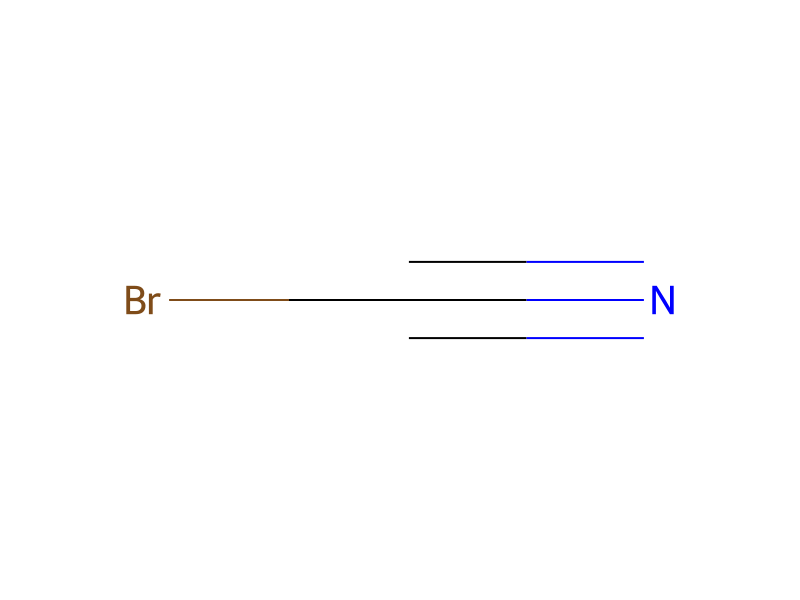
Cyanogen Bromide → 4,5-Dichloro-2-(3,4-dichlorophenyl)pyrrole-1,3-dicarbonitrile
Reaction equation

CC(C)([O-])C.[K+].[C:7]([C:9]1[C:13]([Cl:14])=[C:12]([Cl:15])[NH:11][C:10]=1[C:16]1[CH:21]=[CH:20][C:19]([Cl:22])=[C:18]([Cl:23])[CH:17]=1)#[N:8].[N:24]#[C:25]Br>C1COCC1>[Cl:14][C:13]1[C:9]([C:7]#[N:8])=[C:10]([C:16]2[CH:21]=[CH:20][C:19]([Cl:22])=[C:18]([Cl:23])[CH:17]=2)[N:11]([C:25]#[N:24])[C:12]=1[Cl:15]Participants
5
Reactant 3


Product 1

Reagents, catalysts & solvents 1

Procedure
Potassium t-butoxide (617 mg, 55 mmol) is added in portions to a solution of 3-cyano-4,5-dichloro-2-(3,4-dichlorophenyl)pyrrole (1.52 g, 5 mmol) in anhydrous THF (20 mL). After 30 minutes, a solution of cyanogen bromide (583 mg, 5.5 mmol) in THF (1 mL) is added. The reaction mixture is stored at room temperature overnight. The solvent is removed in a rotary evaporator. The residue is treated with water and extracted with ethyl acetate. The organic layer is washed with water and saturated sodium chloride and dried (MgSO4). Evaporation and crystallization of the residue from ethyl acetate gives while crystals (1.07 g); mp 250.5°-252.0° C.
Workup
- waitThe reaction mixture is stored at room temperature overnight
- customThe solvent is removed in a rotary evaporator
- additionThe residue is treated with water
- extractionextracted with ethyl acetate
- washThe organic layer is washed with water and saturated sodium chloride
- dry with materialdried (MgSO4)
- customEvaporation and crystallization of the residue from ethyl acetate
Sources & evidence
- ORD record
- ord-c4eb45677bcc466f9b5786109ecfbfb7
- Source dataset
- uspto-grants-1990_05
- Patent number
- US04929634
Reaction notes
Loading…