Trichloromelamine → HCID 11812220, compound
Reaction equation

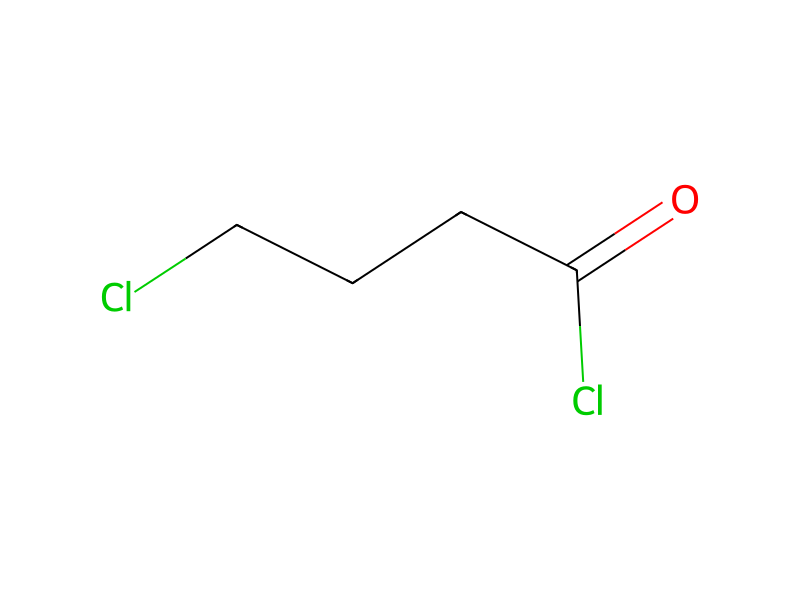
Cl[NH:2][C:3]1[N:8]=[C:7]([NH:9]Cl)[N:6]=[C:5]([NH:11]Cl)[N:4]=1.[Cl:13][CH2:14][CH2:15][CH2:16][C:17](Cl)=[O:18]>C(Cl)(Cl)(Cl)Cl>[Cl:13][CH2:14][CH2:15][CH2:16][C:17]([NH:2][C:3]1[N:8]=[C:7]([NH:9][C:17](=[O:18])[CH2:16][CH2:15][CH2:14][Cl:13])[N:6]=[C:5]([NH:11][C:17](=[O:18])[CH2:16][CH2:15][CH2:14][Cl:13])[N:4]=1)=[O:18]Participants
4
Reactant 2

Product 1

Reagents, catalysts & solvents 1

Conditions
- Temperature
- 60 °C
Procedure
A mixture of 2.3 g trichloromelamine, 20 ml carbon tetrachloride, 8.46 g 4-chlorobutyryl chloride and 30 mg N,N-dimethylaminopyridine was placed in a 100 ml flask fitted with a magnetic stirring bar, a reflux condenser and argon inlet. The reaction mixture was slowly heated in an oil bath to 60° C. and was stirred at 60° C. for 5 hours. It was then allowed to cool down to room temperature and diluted with 50 ml hexanes. The contents were stirred at room temperature for 30 minutes and then filtered. The residue was washed with hexane and dried under reduced pressure. It was characterized to be N,N',N"-tris(4-chlorobutyryl) melamine on the basis of NMR and mass spectroscopy (4.2 g; 95% yield);
Workup
- customwas placed in a 100 ml flask
- customfitted with a magnetic stirring bar, a reflux condenser and argon inlet
- temperatureto cool down to room temperature
- stirringThe contents were stirred at room temperature for 30 minutes
- filtrationfiltered
- washThe residue was washed with hexane
- customdried under reduced pressure
Sources & evidence
- ORD record
- ord-c2979e24c31a4a04984cea9c6e1944b7
- Source dataset
- uspto-grants-1995_04
- Patent number
- US05405959
Reaction notes
Loading…