Carbon Dioxide → Dichromate ion
Reaction equation

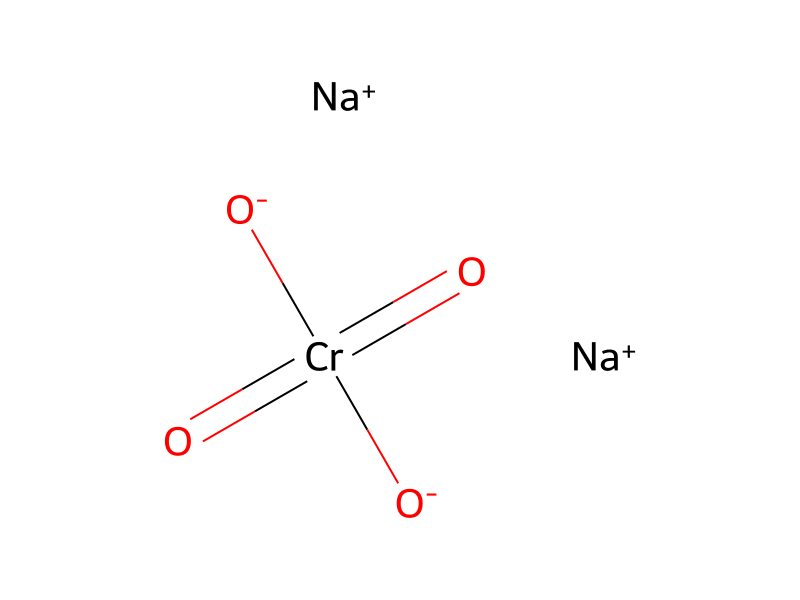
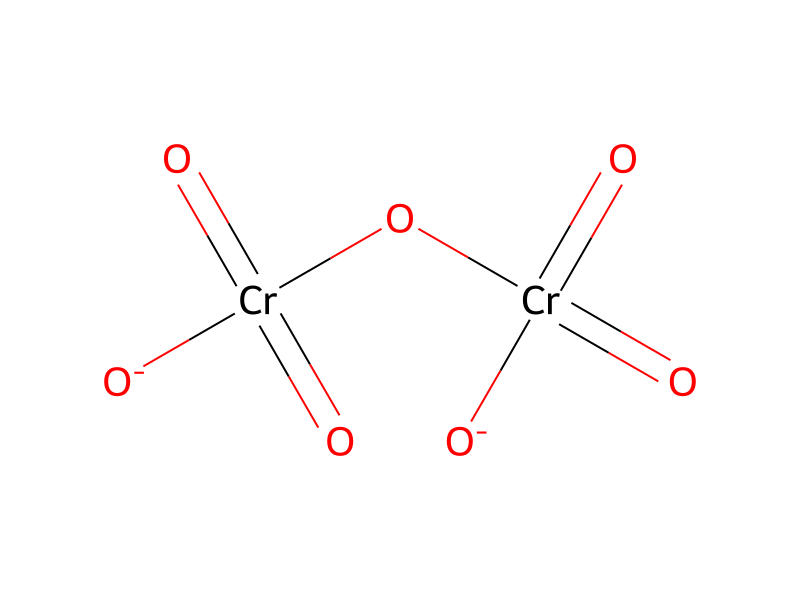
C(=O)=O.[Cr:4]([O-:8])([O-:7])(=[O:6])=[O:5].[Na+:9].[Na+].[C:11](=[O:14])([OH:13])[OH:12]>>[Cr:4]([O:8][Cr:4]([O-:7])(=[O:6])=[O:5])([O-:7])(=[O:6])=[O:5].[C:11](=[O:12])([O-:14])[OH:13].[Na+:9]Participants



Procedure
For acidification with carbon dioxide, the sodium monochromate solution is adjusted to a concentration of from 750 to 1,000 g/l Na2CrO4 and is saturated with carbonic acid in autoclaves by introduction of carbon dioxide under a pressure of from 0.5 to 1.5 MPa (5 to 15 bar). 75 to 95% conversion of monochromate ions into dichromate ions is obtained with precipitation of sodium hydrogen carbonate. The remaining conversion to 100% can be obtained by introduction of carbon dioxide in another stage after concentration to 1,300 g/l Na2CrO4 (already formed Na2CrO7.2H2O expressed in Na2CrO4 equivalents). On an industrial scale, however, this final conversion step is very complicated. The final conversion step may also be carried out with sulfuric acid or by electrolysis.
Sources & evidence
- ORD record
- ord-b3c5a56be3c7408b8f31fe27749cb05c
- Source dataset
- uspto-grants-1993_10
- Patent number
- US05250274
Reaction notes
Loading…