Ammonia → 3,5-Dihydroxyethyl benzyl alcohol
Reaction equation

[CH2:1](N)[CH2:2]N.N.OC[C:8]([CH2:13][OH:14])([CH2:11][OH:12])CO.[OH:15][CH2:16][C:17]([CH2:21]O)(CO)[CH3:18].OC1C=CC(C(C2C=CC(O)=CC=2)(C2C=CC(O)=CC=2)C)=CC=1.NC(CC)C(N)=O>O>[OH:14][C:13]1[CH:18]=[C:17]([CH:21]=[C:11]([OH:12])[CH:8]=1)[CH:16]([OH:15])[CH2:1][CH3:2]Participants



Procedure
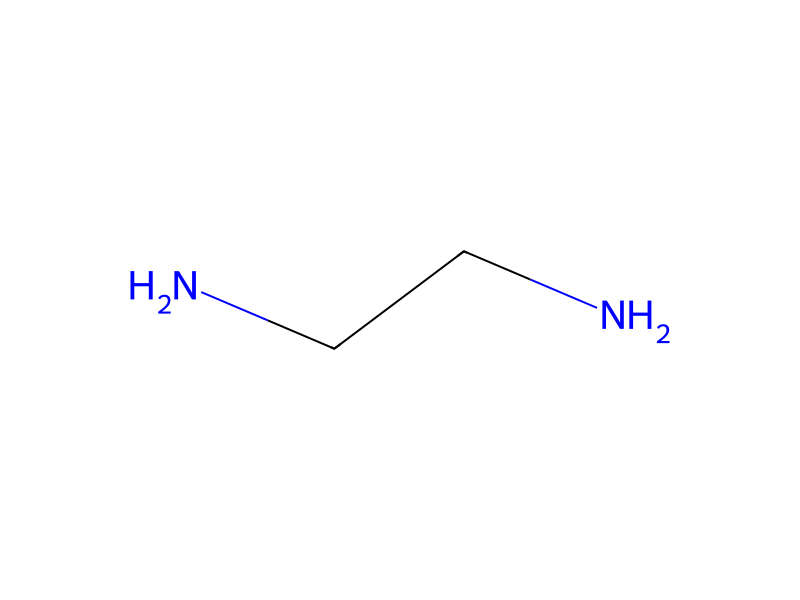
Another embodiment of the present invention is directed to an ink composition comprising water, an anionic dye, a monoamine compound, and a first generation dendrimer compound having terminal primary amine groups. The monoamine compound in this embodiment is as described herein for the embodiment containing the polyamine and the monoamine. Dendrimers are known, and can be considered radially symmetrical molecules of a starburst topology comprising an initiator core, such as nitrogen, ethylenediamine, and the like, interior layers attached to the core and comprising, for example, three or four arms, each arm being composed of repeating units, with the number of repeating units in each arm being considered the generation of the dendrimer, and terminal functional groups functionality, such as a primary amine attached to the outermost generation. Dendrimers are illustrated in, for example, U.S. Pat. Nos. 5,120,361, 4,507,466, 4,631,337, 4,558,120, 4,568,737, 4,587,329, and D. A. Tomalia, A. M. Naylor, and W. A. Goddard III, Angewandte Chemie, Int. Ed. Engl. 29, 138 (1990), the disclosures of each of which are totally incorporated herein by reference. The size and shape of the starburst dendrimer molecule and the functional groups present in the dendrimer molecule can be controlled by the choice of the initiator core, the number of generations, and the choice of repeating units employed at each generation. The choice of the dendrimer components can affect the properties of the dendrimers. The initiator core type can affect the dendrimer shape, producing, for example, spheroid-shaped dendrimers, cylindrical- or rod-shaped dendrimers, or ellipsoid-shaped dendrimers. Sequential building of generations determines the dimensions of the dendrimers and the nature of its interior. Examples of suitable core materials include ammonia, polyfunctional alcohols, such as pentaerythritol or tris-(hydroxymethyl)ethane, 1,1,1-tris-(4'-hydroxyphenyl)-ethane, polyfunctional amines, such as ethylene diamine, linear polyethyleneimines, and the like. The chemical functionality of the repeating unit in the interior layers can include, for example, amidoamines, such as amino-ethyl acetamide, imines, such as diethylene diimine, or ethers such as those obtained from materials such as 3,5-dihydroxyethyl benzyl alcohol. The terminal functionalities include, for example, amino groups, hydroxyl groups, carboxylic acid groups, carboxylates, esters, amides, phosphates, sulfonates, and the like. The synthesis of dendrimers usually occurs by a divergent approach that involves the initial reaction of a monomer with the initiator core, followed by exhaustive reaction of the resulting functional groups with a difunctional compound, such as a diamine, including, for example, ethylene diamine, to afford the next generation of reactive amino groups. Repetition of the two-step procedure leads to subsequent generations. An alternate synthetic route uses a convergent growth synthesis as described in detail in C. J. Hawker and J. M. J. Frechet, J. Am. Chem. Soc., 112, 7638 (1990), the disclosure of which is totally incorporated herein by reference. Examples of dendrimers prepared by the divergent approach include the STARBURST® available from Dow Chemical Company, Dendrimer Microparticles available from Polysciences, Inc., in which the terminal functional groups are primary amino groups, and which range in average diameter of from about 10.8 Angstroms (first generation) to about 83.9 Angstroms (8th generation). One specific example of a dendrimer molecule suitable for the inks of the present invention is a first generation dendrimer based on ethylenediamine, available as STARBURST® First Generation 10 Angstrom from Polysciences Inc., Warrington, Pa., with the structural formula: ##STR26## The dendrimer compound is present in the ink in any effective amount, typically from about 0.1 to about 10 percent by weight, and preferably from about 1 to about 5 percent by weight, although the amount can be outside this range. Typically, the monoamine is present in these inks an amount relative to the dye such that the molar ratio of dye to monoamine is 1 mole equivalent of dye molecules to from about 2 to about 10 mole equivalents of the monoamine molecules. Typically, the dendrimer compound is present in an amount relative to the dye such that the molar ratio of dye to dendrimer is 1 mole equivalent of dye molecules to from about 0.3 to about 4.5 mole equivalents of dendrimer molecules. Typically, the molar ratio of monoamine molecules to dendrimer molecules is from about 1 mole equivalent of monoamine molecules to from about 0.033 to about 2 mole equivalents of dendrimer molecules. The relative amounts of these compounds, however, can be outside these ranges.
Sources & evidence
- ORD record
- ord-32eb18119a074d74bd27e91a9d4037cf
- Source dataset
- uspto-grants-1993_10
- Patent number
- US05254159
Reaction notes
Loading…