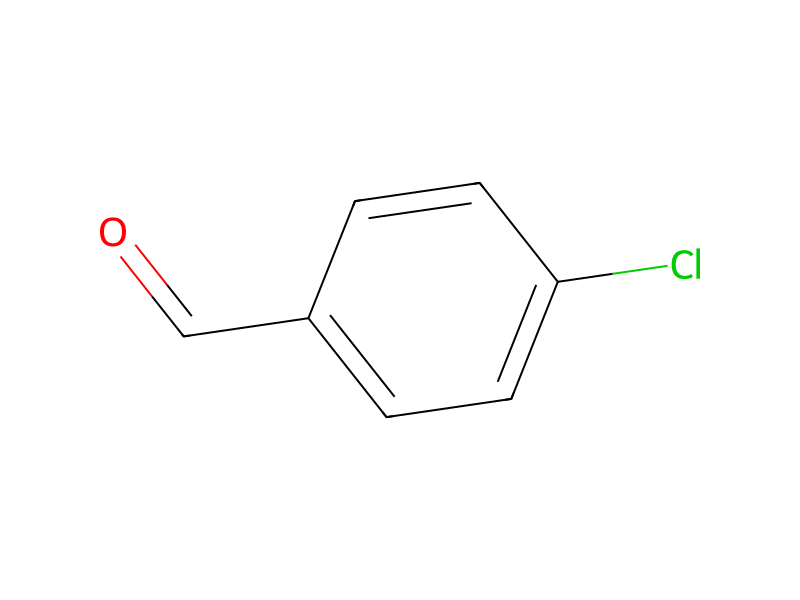
4-Chlorobenzaldehyde → 5-[(4-Chlorophenyl)methylidene]-2,2-dimethylcyclopentan-1-one
Reaction equation

[OH-].[Na+].[CH3:3][C:4]1([CH3:10])[CH2:8][CH2:7][CH2:6][C:5]1=[O:9].[Cl:11][C:12]1[CH:19]=[CH:18][C:15]([CH:16]=O)=[CH:14][CH:13]=1>C(O)C>[CH3:3][C:4]1([CH3:10])[CH2:8][CH2:7][C:6](=[CH:16][C:15]2[CH:18]=[CH:19][C:12]([Cl:11])=[CH:13][CH:14]=2)[C:5]1=[O:9]Participants
Reactant 3

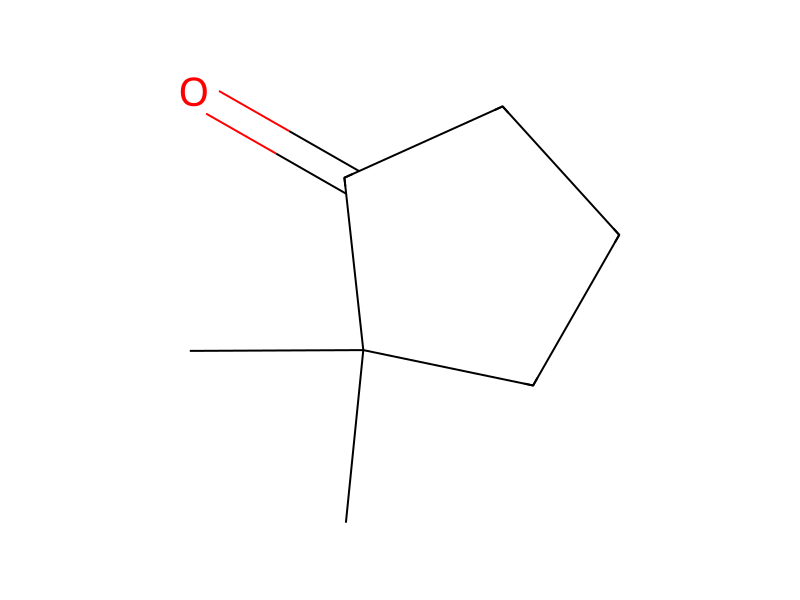
Product 1

Reagents, catalysts & solvents 1

Procedure
10% strength aqueous sodium hydroxide solution (100 cc) is added to a mixture of 2,2-dimethylcyclopentanone (10 g) and 4-chlorobenzaldehyde (13.8 g) in ethanol (100 cc) at 0° C. After 30 minutes, a thick slurry is filtered and the solid washed and then dried. 2,2-Dimethyl-5-(4-chlorobenzylidene)-1-cyclopentanone (12.5 g) m.p. 120° C., is obtained. This compound, dissolved in THF (50 cc) is added to a solution formed in the following manner: sodium hydride (1.9 g; 80% strength dispersion in mineral oil) in anhydrous DMSO (50 cc) is heated to 80° until the solid has dissolved completely. The solution is then diluted with THF (100 cc) and thereafter cooled to -10° C. A solution of trimethylsulphonium iodide (11.5 g) in dimethyl sulphoxide (80 cc) is added to the mixture in the course of 10 minutes and the mixture is stirred for 15 minutes at -10° C. A solution of 2,2-dimethyl-4-chloro-5-(4-chlorobenzylidene) -1-cyclopentanone (11.8 g) is then added in THF (100 cc).
Workup
- filtrationa thick slurry is filtered
- washthe solid washed
- customdried
Sources & evidence
- ORD record
- ord-ed8ed038031041e082a55efa56348d82
- Source dataset
- uspto-grants-1993_10
- Patent number
- US05256683
Reaction notes
Loading…