Ethyl vinyl ether → 2-(2-Formylethyl)-3-isopropenyl-1-methyl-cyclopent-1-ene
Reaction equation

[C:1]([CH:4]1[CH2:8][CH2:7][C:6]([CH3:10])(O)[C:5]1=[CH2:11])([CH3:3])=[CH2:2].[CH:12]([O:14]CC)=[CH2:13]>P(=O)(O)(O)O>[CH:12]([CH2:13][CH2:11][C:5]1[CH:4]([C:1]([CH3:3])=[CH2:2])[CH2:8][CH2:7][C:6]=1[CH3:10])=[O:14]Participants
Reactant 2
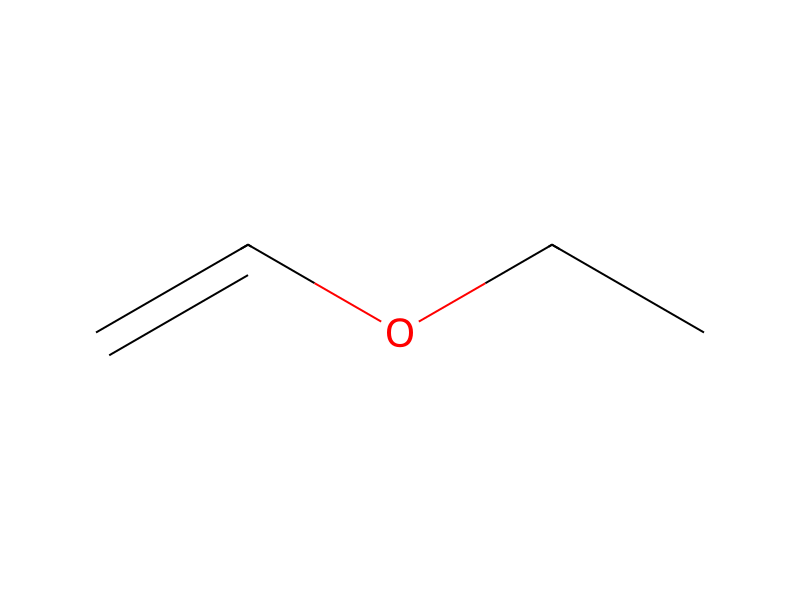

Product 1

Reagents, catalysts & solvents 1

Procedure
12 drops of 85% phosphoric acid were added to a mixture, cooled to -15°C in a laboratory autoclave, of 76 g of 3-isopropenyl-1-methyl-2-methylene-cyclopentan-1-ol and 72 g of ethyl vinyl ether. After gassing with argon, the autoclave was brought, in an oil bath of 180°C, to an internal temperature of 150°C (this took about 15 minutes) and held at this temperature until a distinct drop in pressure occurred (about 100 minutes). The reaction mixture was then quenched, taken up in ether, washed with aqueous bicarbonate solution and water, the solution dried over anhydrous magnesium sulphate and concentrated under reduced pressure. The crude product (110 g), obtained as a yellow oil, was fractionated and yielded 61 g (68%) of pure 2-(2-formylethyl)-3-isopropenyl-1-methyl-cyclopent-1-ene having a woody, earthy fragrance; boiling point 0.2 = 64°-65°C; nD20 = 1.4888; IRfilm : μmax = 3080, 2725, 1725, 1642, 1440, 1370, 1060 and 895 cm-1.
Workup
- customthe autoclave was brought, in an oil bath of 180°C, to an internal temperature of 150°C
- customthis took about 15 minutes
- custom(about 100 minutes)
- customThe reaction mixture was then quenched
- washwashed with aqueous bicarbonate solution and water
- dry with materialthe solution dried over anhydrous magnesium sulphate
- concentrationconcentrated under reduced pressure
- customThe crude product (110 g), obtained as a yellow oil
Sources & evidence
- ORD record
- ord-04e7147d167a4ff8b0e8ba863d975367
- Source dataset
- uspto-grants-1976_06
- Patent number
- US03963675
Reaction notes
Loading…