Nitric Acid → 9,10-Anthracenedione, 1,5-dinitro-
Reaction equation

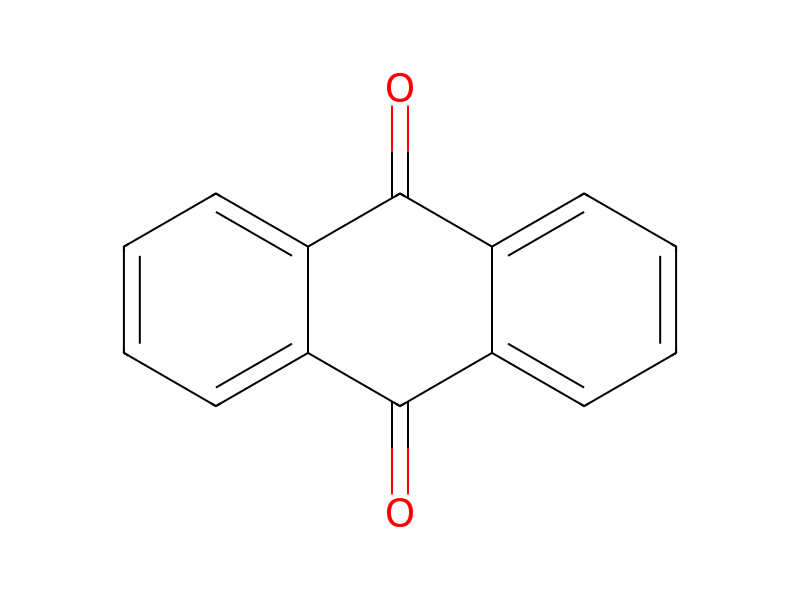
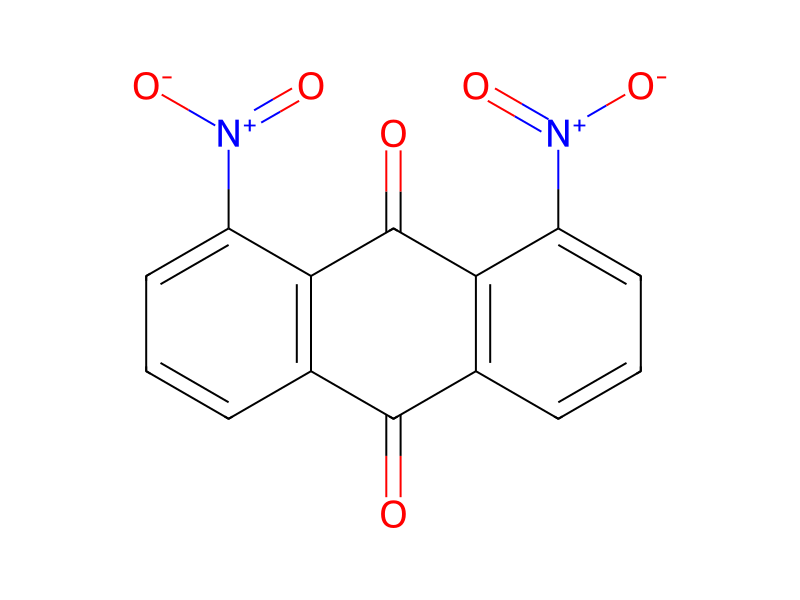
[N+:1]([C:4]1[C:17]2[C:16](=[O:18])[C:15]3[C:10](=[CH:11][CH:12]=[CH:13][C:14]=3[N+]([O-])=O)[C:9](=[O:22])[C:8]=2[CH:7]=[CH:6][CH:5]=1)([O-:3])=[O:2].C1C2C(=O)C3C(=CC=CC=3)C(=O)C=2C=CC=1.[N+:39]([O-])([OH:41])=[O:40]>OS(O)(=O)=O>[N+:39]([C:11]1[C:10]2[C:9](=[O:22])[C:8]3[C:17](=[C:4]([N+:1]([O-:3])=[O:2])[CH:5]=[CH:6][CH:7]=3)[C:16](=[O:18])[C:15]=2[CH:14]=[CH:13][CH:12]=1)([O-:41])=[O:40]Participants
Reactant 3

Product 1

Reagents, catalysts & solvents 1

Procedure
Similarly, there has hitherto been no commercially and economically practicable process for the production of pure 1,8-dinitroanthraquinone. It is known that the commercially very important α,α-dinitration products of anthraquinone can be obtained in particularly high yields by nitration in concentrated nitric acid. Since the quantity of nitric acid required for this process is not appreciably higher than the quantity of sulphuric acid required for dinitration in H2SO4, nitric acid is economically superior to dinitration in sulfuric acid. The much simpler regeneration of the solvent is another factor in favour of nitric acid. According to Moiseva (Org.Polyprod, i. Krasitel, Moscow 1969, No. 4, 70-79), it is possible by the nitric acid process to obtain a 1,5-dinitroanthraquinone in a yield of 30 % of the theoretical amount. However, it is not possible under the conditions quoted by Moiseva (98 % HNO3, 24 hours at 24°-25°C) to obtain pure 1,5-dinitroanthraquinone. Instead the products obtained still contain at least 5 % of 1,8-dinitroanthraquinone (cf. Example 18 below). Even under more stringent conditions (filtration under suction at elevated temperature, increasing the quantity of nitric acid used for washing), we were unable to obtain 1,5-dinitroanthraquinone with a purity of more than 95 % in a yield of more than 20 % of the theoretical amount. In addition, it is subsequently no longer possible to isolate pure 1,8-dinitroanthraquinone from the mother liquors, because they then contain too much 1,5-dinitroanthraquinone.
Workup
- customcan be obtained
Sources & evidence
- ORD record
- ord-7a08b166c4cd485a8a22444f8c295382
- Source dataset
- uspto-grants-1976_06
- Patent number
- US03963762
Reaction notes
Loading…