Hydrochloric Acid → 2,3-Dichlorobenzyl alcohol
Reaction equation

[Cl:1][C:2]1[C:10]([Cl:11])=[CH:9][CH:8]=[CH:7][C:3]=1[C:4](O)=[O:5].[H-].C([Al+]CC(C)C)C(C)C.CO.Cl>C1(C)C=CC=CC=1.O>[Cl:1][C:2]1[C:10]([Cl:11])=[CH:9][CH:8]=[CH:7][C:3]=1[CH2:4][OH:5]Participants
Reactant 4


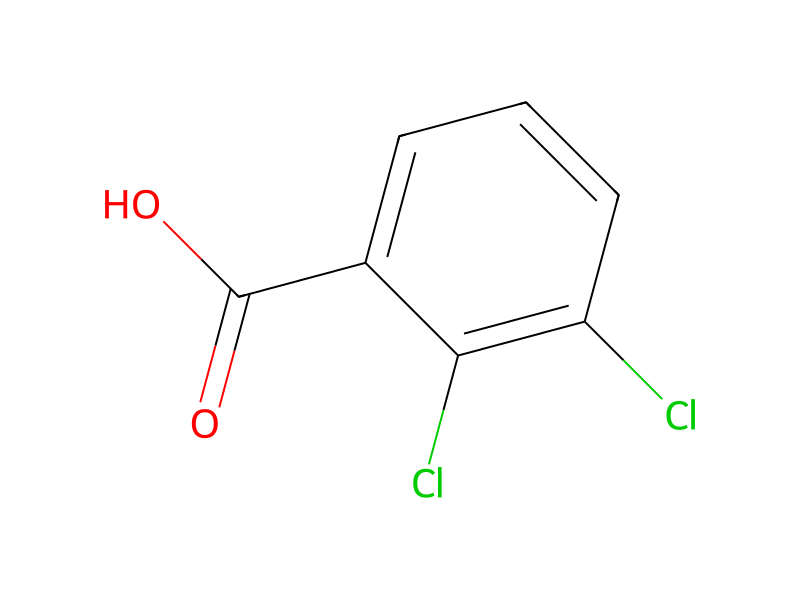

Product 1

Reagents, catalysts & solvents 2


Procedure
A 20.0 (0.105 mole) portion of 2,3-dichlorobenzoic acid in 100 ml of toluene was treated with 254 ml (0.315 mole) of diisobutylaluminum hydride (25% in hexane), under a stream of dry nitrogen, at 15°-20° over 0.5 hours using rapid stirring. The reaction mixture was allowed to warm to room temperature over 0.5 hours, heated to reflux over 0.5 hours, refluxed for 1.5 hours, allowed to cool slowly to room temperature, and stored overnight at room temperature. The reaction mixture was then treated with a solution of 100 ml of methanol in 100 ml of water at 10°-15°, followed by 100 ml of concentrated hydrochloric acid at 20°-25°, and 165 ml of water. The organic layer was separated, washed with 50 ml of 5% sodium bicarbonate, 50 ml of water, dried over magnesium sulfate overnight and filtered. The filtrate was concentrated to dryness to given 17.0 g (91%) of a light tan solid, m.p. 81°-84°.
Workup
- temperatureheated
- temperatureto reflux over 0.5 hours
- temperaturerefluxed for 1.5 hours
- temperatureto cool slowly to room temperature
- customThe organic layer was separated
- washwashed with 50 ml of 5% sodium bicarbonate, 50 ml of water
- dry with materialdried over magnesium sulfate overnight
- filtrationfiltered
- concentrationThe filtrate was concentrated to dryness
Sources & evidence
- ORD record
- ord-2822d0ca1a104c3891d398cbc519ae83
- Source dataset
- uspto-grants-1976_06
- Patent number
- US03966758
Reaction notes
Loading…