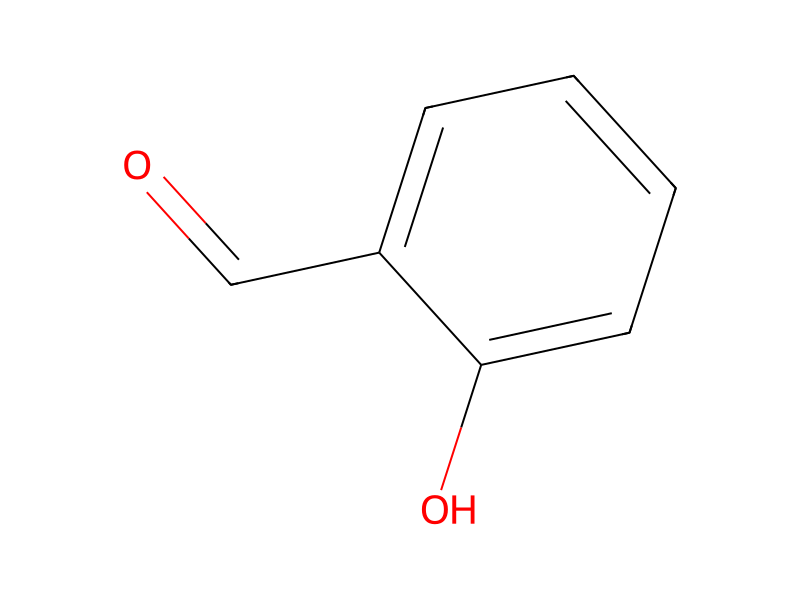
Water → Salicylaldehyde
Reaction equation

[OH-].[Na+].O.[OH:4][C:5]1[CH:12]=[CH:11][CH:10]=[CH:9][C:6]=1[CH2:7][OH:8]>[Pd].C(Cl)Cl>[OH:4][C:5]1[CH:12]=[CH:11][CH:10]=[CH:9][C:6]=1[CH:7]=[O:8]Participants
6
Reactant 3



Product 1
Reagents, catalysts & solvents 2


Procedure
In substantially the same manner as in Example 1, 0.16 part of sodium hydroxide, 60 parts of water, 3.2 parts of 5 percent palladium-on-charcoal, 264 parts of methylene chloride and 5 parts of o-hydroxybenzyl alcohol are stirred in the presence of air and refluxed at 45° C.-48° C. for approximately three hours; VPC analysis of the reaction mixture at 160° C. reveals aldehyde formation. The crude reaction mixture is filtered and separated as in Example 1. 2.01 Parts of o-hydroxybenzaldehyde are isolated; 1.49 parts of unreacted o-hydroxybenzyl alcohol are also recovered indicating the reaction had not gone to completion.
Workup
- temperaturerefluxed at 45° C.-48° C. for approximately three hours
- customat 160° C.
- customThe crude reaction mixture
- filtrationis filtered
- customseparated as in Example 1
Sources & evidence
- ORD record
- ord-82dc22f6d4954e3f986967d5ae9b8e39
- Source dataset
- uspto-grants-1981_12
- Patent number
- US04306083
Reaction notes
Loading…