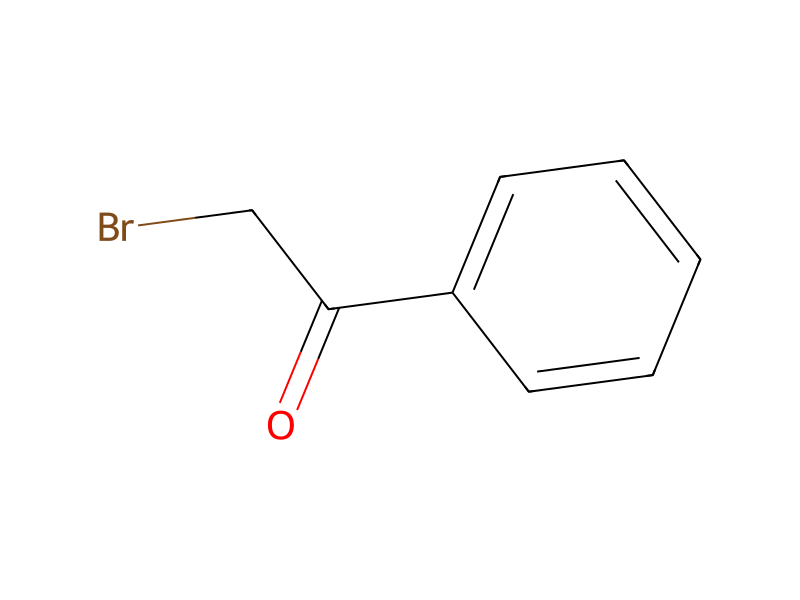
Phenacyl bromide → HCID 20558013, compound
Reaction equation

[CH2:1]([NH:9][C:10]([NH2:12])=[S:11])[CH2:2][C:3]1[CH:8]=[CH:7][CH:6]=[CH:5][CH:4]=1.[Br:13][CH2:14][C:15]([C:17]1[CH:22]=[CH:21][CH:20]=[CH:19][CH:18]=1)=O>C(O)C>[BrH:13].[CH2:1]([NH:9][C:10]1[S:11][CH:14]=[C:15]([C:17]2[CH:22]=[CH:21][CH:20]=[CH:19][CH:18]=2)[N:12]=1)[CH2:2][C:3]1[CH:8]=[CH:7][CH:6]=[CH:5][CH:4]=1Participants
Reactant 2

Product 1

Reagents, catalysts & solvents 1

Procedure
N-phenethylthiourea (225 grams, 1.25 moles) and α-bromoacetophenone (250 grams, 1.25 moles, Aldrich Chem. Co.) in 1500 ml absolute ethanol were heated to reflux temperature for 21/2 hours under nitrogen. After reducing the solvent volume by 10%, the reaction mixture was cooled to room temperature and then to 0° C. in an ice bath. The solids were filtered off, redissolved in 2,500 ml of absolute ethanol and heated to reflux. The solvent volume was reduced to 2000 ml and the reaction mixture cooled to 0° C. This procedure was repeated and after the second recrystallization the solids were collected and dried under vacuum over phosphorous pentoxide, yielding 365 grams (81%) of 2-phenethylamino-4-phenyl-thiazole hydrobromide, m.p. 169°-172° C.
Workup
- temperatureto reflux temperature for 21/2 hours under nitrogen
- customto 0° C.
- filtrationThe solids were filtered off
- dissolutionredissolved in 2,500 ml of absolute ethanol
- temperatureheated to reflux
- temperaturethe reaction mixture cooled to 0° C
- customafter the second recrystallization the solids
- customwere collected
- dry with materialdried under vacuum over phosphorous pentoxide
Sources & evidence
- ORD record
- ord-97691aaa5b5b48bda268ee6ef7825ddc
- Source dataset
- uspto-grants-1981_12
- Patent number
- US04307106
Reaction notes
Loading…