Potassium Carbonate → HCID 20556874, compound
Reaction equation

[CH3:1][C:2]1[CH:7]=[CH:6][C:5]([OH:8])=[C:4]([SH:9])[CH:3]=1.Br[CH:11]([CH2:17]Br)[C:12]([O:14]CC)=[O:13].C(=O)([O-])[O-].[K+].[K+]>CC(C)=O>[CH3:1][C:2]1[CH:7]=[CH:6][C:5]2[O:8][CH:11]([C:12]([OH:14])=[O:13])[CH2:17][S:9][C:4]=2[CH:3]=1Participants
Reactant 3

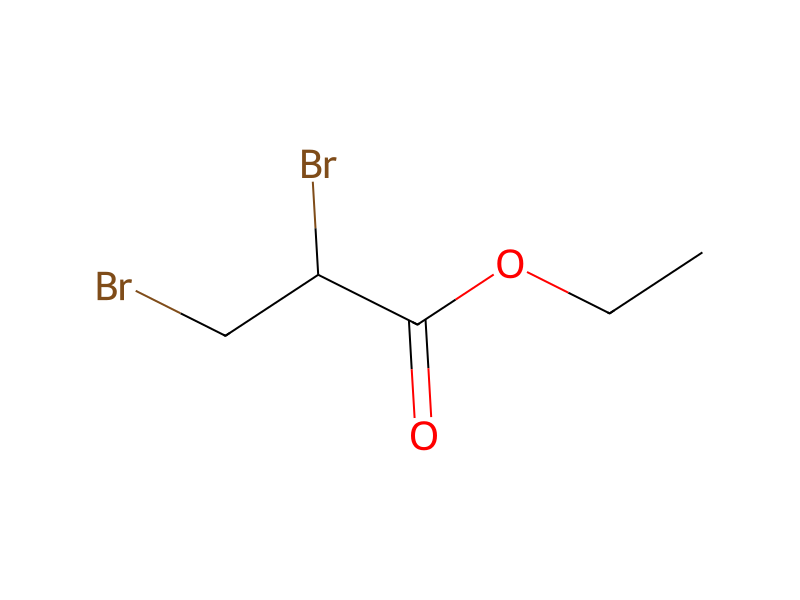

Product 1

Reagents, catalysts & solvents 1

Procedure
A solution of 20.0 g of 4-methyl-2-mercaptophenol in 75 ml of acetone was added slowly to a stirred mixture of 40.2 g of ethyl 2,3-dibromopropionate and 10.2 g of potassium carbonate in 400 ml of acetone, at room temperature. The mixture was stirred at room temperature for 10 minutes, then refluxed for 16 hours. The mixture was filtered and the solid was washed with acetone. The acetone filtrate was stripped of solvent; the residue was dissolved in methylene chloride, the solution was washed with water, then dried (MgSO4) and stripped of solvent. The liquid residue was dry column chromatographed (silica gel) using Solvent No. 2 as eluent. The first band (high Rf) was collected and extracted with ether. The solvent was stripped from the extract. The residue was dried (vacuum, 24 hours) and crystallized from hexane to give the ethyl ester of 2,3-dihydro-6-methyl-1,4-benzoxathiin-2-carboxylic acid (2A), as white needles, mp: 41°-43° C.
Workup
- temperaturerefluxed for 16 hours
- filtrationThe mixture was filtered
- washthe solid was washed with acetone
- dissolutionthe residue was dissolved in methylene chloride
- washthe solution was washed with water
- dry with materialdried (MgSO4)
- customThe liquid residue was dry column
- customchromatographed (silica gel)
- customThe first band (high Rf) was collected
- extractionextracted with ether
- customThe residue was dried (vacuum, 24 hours)
- customcrystallized from hexane
Sources & evidence
- ORD record
- ord-1c57fa6595cc4696a5c66fd35522ac93
- Source dataset
- uspto-grants-1981_12
- Patent number
- US04308276
Reaction notes
Loading…