Sodium Hydroxide → 5-Hydroxyindole-3-carboxamide
Reaction equation

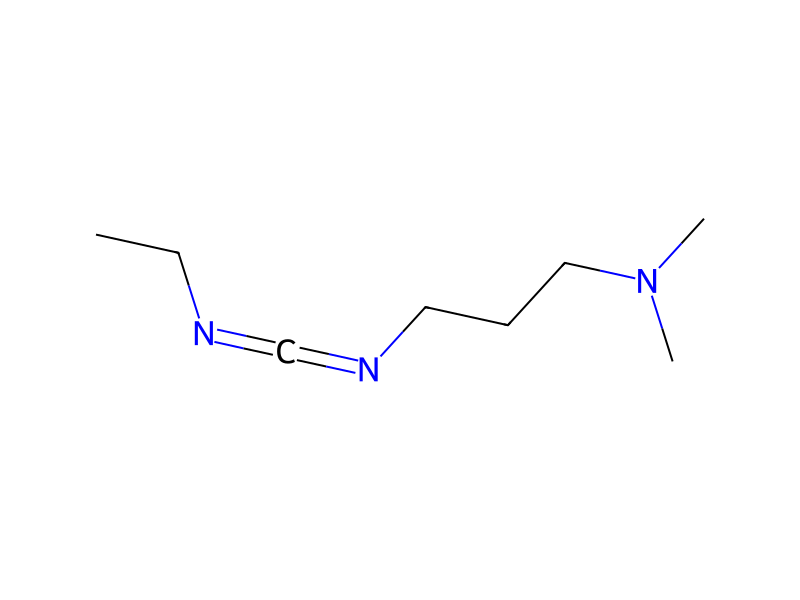
[OH-].[Na+].[OH:3][C:4]1[CH:5]=[C:6]2[C:10](=[CH:11][CH:12]=1)[NH:9][CH:8]=[C:7]2[C:13]([OH:15])=O.C[N:17](C)CCCN=C=NCC>C(O)C>[OH:3][C:4]1[CH:5]=[C:6]2[C:10](=[CH:11][CH:12]=1)[NH:9][CH:8]=[C:7]2[C:13]([NH2:17])=[O:15]Participants
Reactant 3


Product 1

Reagents, catalysts & solvents 1

Procedure
In general, a beta-ketoester (e.g. ethyl acetoacetate) is treated with an amine (e.g. 2-thiophenemethyl amine) in the presence of an organic acid (e.g. para-toluenesulfonic acid) and 1,4-benzoquinone to produce a 5-hydroxyindole-3-carboxylic acid (e.g. 5-hydroxy-2-methyl-1-(2-thiophenemethyl)indole-3-carboxylic acid) after hydrolysis of the ester with a strong base such as sodium hydroxide in a suitable solvent such as ethanol. The carboxylic acid is further reacted with an amine in the presence of N-(3-dimethylaminopropyl)-N′-ethylcarbodimide (EDC) to produce 5-hydroxyindole-3-carboxamide (e.g. 3,4-difluorophenylmethyl 5-hydroxy-2-methyl-1-(2-thiophenemethyl)indole-3-carboxamide). The carboxylic acid may also be treated with an alcohol or thiol in the presence of EDC to produce an ester and thiol ester derivatives, respectively,
Sources & evidence
- ORD record
- ord-2e15ecf9dc004c9081518b82d9861a85
- Source dataset
- uspto-grants-2010_06
- Patent number
- US07737173B2
Reaction notes
Loading…