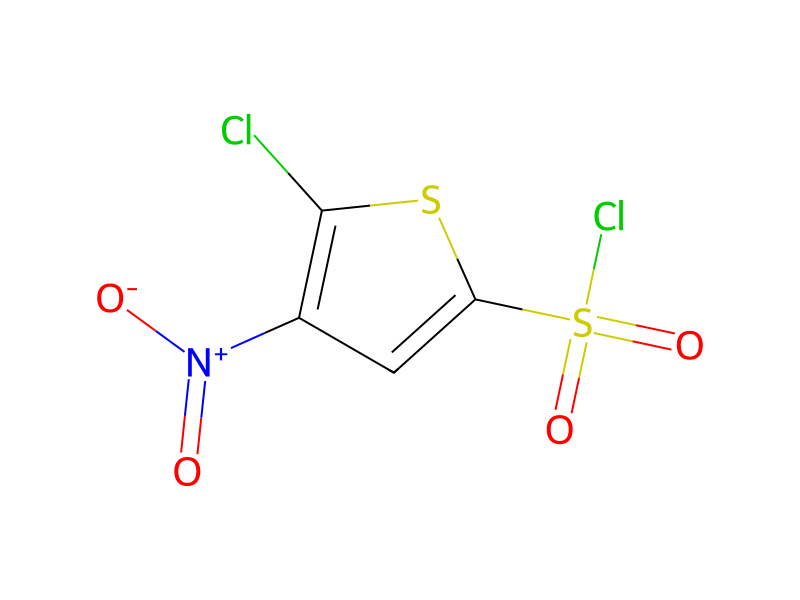
5-Chloro-4-nitrothiophene-2-sulfonyl chloride → HCID 86632423, compound
Reaction equation

[Cl:1][C:2]1[S:6][C:5]([S:7](Cl)(=[O:9])=[O:8])=[CH:4][C:3]=1[N+:11]([O-:13])=[O:12].C(=O)([O-])[O-:15].[Ag+2:18].CCCCCC.C(OCC)(=O)C>C(#N)C.O>[Cl:1][C:2]1[S:6][C:5]([S:7]([O-:15])(=[O:9])=[O:8])=[CH:4][C:3]=1[N+:11]([O-:13])=[O:12].[Ag+:18]Participants





Procedure
To a solution of 5-chloro-4-nitrothiophene-2-sulfonyl chloride (0.393 g, 1.5 mmol) in 15 mL of acetonitrile and 2 mL of water was added silver carbonate (0.414 g, 1.5 mmol) in portions in darkness. The resulting suspension was stirred overnight for 3 days, until no starting material is shown on the thin layer chromatography with an eluant of hexane/ethyl acetate (1:4). The mixture was filtered through half an inch of Celite® and the solid was washed with 3×15 mL acetonitrile. The organic filtrate was combined and organic solvent was removed via rotary evaporator to dryness and thus afforded 0.507 g of viscous solid with a yield of 96.4%. The resulting compound was not purified for further reactions. 1HNMR, d6-DMSO: 7.49 (d, 1H, 0.8 Hz)
Workup
- filtrationThe mixture was filtered through half an inch of Celite®
- washthe solid was washed with 3×15 mL acetonitrile
- customorganic solvent was removed via rotary evaporator to dryness and thus afforded 0.507 g of viscous solid with a yield of 96.4%
- customThe resulting compound was not purified for further reactions
Sources & evidence
- ORD record
- ord-18ec2c612b6a4cc3af42b18173f42eb2
- Source dataset
- uspto-grants-2011_10
- Patent number
- US08034533B2
Reaction notes
Loading…