Tetrahydrofuran → Cycloheptanemethanol
Reaction equation
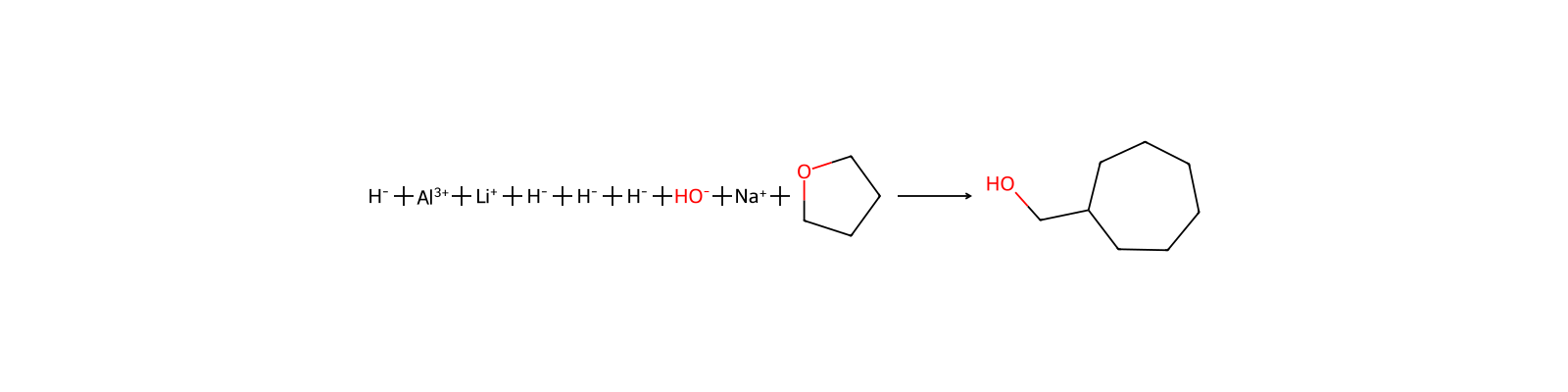
[H-].[Al+3].[Li+].[H-].[H-].[H-].[OH-].[Na+].[CH2:9]1[CH2:13][O:12][CH2:11][CH2:10]1>>[CH:9]1([CH2:13][OH:12])[CH2:10][CH2:11][CH2:11][CH2:10][CH2:9][CH2:13]1Participants




Conditions
- Temperature
- -40 °C
Procedure
Methanol (20 ml) was cooled to 0° C. and acetyl chloride (2.0 ml) was added. The mixture was stirred for 10 minutes and cycloheptanecarboxylic acid (2.0 ml) was added. The cooling bath was removed and the mixture was heated to reflux and stirred for 8 hours. The mixture was cooled to room temperature and the solvent was evaporated under reduced pressure. The residue was extracted with EtOAc. The organic layer washed with saturated aqueous sodium bicarbonate, dried (Na2SO4) and evaporated under reduced pressure, affording cycloheptanecarboxylic acid methylester (1.82 g) as a pale yellow liquid. This methylester intermediate (1.8 g) was dissolved in THF (25 ml) and cooled to −40° C. Lithium aluminium hydride (11.5 ml of a 1.0 M sol. in THF) was added drop-wise. The reaction mixture was allowed slowly to warm to 0° C. and stirring was continued at this temperature for 3 hours. Aqueous sodium hydroxide (5 ml of a 1 M sol.) was added and the mixture was filtrated. The filtrate was evaporated under reduced pressure and re-dissolved in EtOAc (20 ml), dried (Na2SO4) and evaporated under reduced pressure, and gave cycloheptyl-methanol (1.37 g) as a clear colourless oil. This alcohol intermediate was converted into the title compound, as described for preparation 66, using N-hydroxyphthalimide. 13C-NMR (DMSO-d6) δ 78.8, 37.1, 30.0, 27.9, 25.6.
Workup
- temperatureto warm to 0° C.
- filtrationthe mixture was filtrated
- customThe filtrate was evaporated under reduced pressure
- dissolutionre-dissolved in EtOAc (20 ml)
- dry with materialdried (Na2SO4)
- customevaporated under reduced pressure
Sources & evidence
- ORD record
- ord-75a15f611137424ba0ef292aba8af47c
- Source dataset
- uspto-grants-2011_10
- Patent number
- US08034811B2
Reaction notes
Loading…