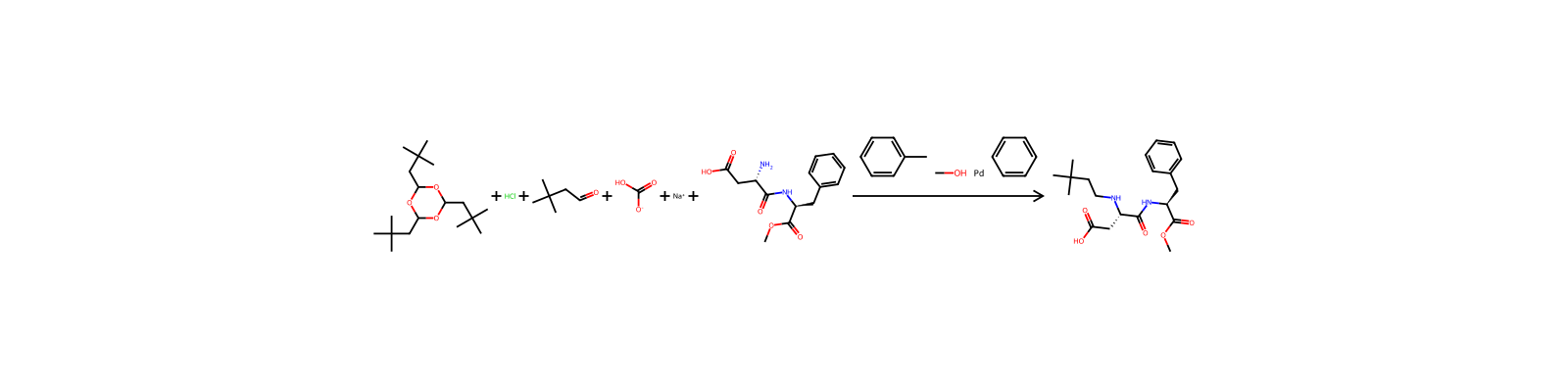
Participants
| Role | Name | HCID | Charge |
|---|
| Reactant | Hydrochloric Acid | HCID 313 | — |
| Reactant | 3,3-Dimethylbutanal | HCID 76335 | — |
| Reactant | Aspartame | HCID 134601 | — |
| Reactant | Sodium Bicarbonate | HCID 516892 | — |
| Reactant | HCID 3742834 | HCID 3742834 | — |
| Catalyst | Palladium | HCID 23938 | — |
| Solvent | Benzene | HCID 241 | — |
| Solvent | Methanol | HCID 887 | — |
| Solvent | Toluene | HCID 1140 | — |
| Product | Neotame | HCID 9810996 | 57% |
Reaction Steps
2,4,6-Trineopentyl-1,3,5-trioxane (3.3 g, about 10.7 mmol) was dissolved in toluene (3 mL) and 0.5 mL of 20% aqueous hydrochloric acid was added. The mixture was refluxed under nitrogen atmosphere for 1 hour (68-69° C.). The NMR analysis showed the only signals corresponding to 3,3-dimethylbutyraldehyde and benzene. The mixture was neutralized with sodium bicarbonate to pH=7 and the organic layer was transferred to the stirred suspension of aspartame (9.4 g, 31.9 mmol) and Pd/C (0.4 g) in methanol (150 mL) under nitrogen. Nitrogen was removed by hydrogen and the reaction mixture was vigorously stirred for 14 hours under light hydrogen pressure (<1 psi). Then, the mixture was filtered through Celite. The Celite layer was washed with methanol (25 mL) and evaporated under vacuum to half (about 80-90 mL), filtered and water (about 100 mL) was added to the residue. The mixture was gently evaporated under vacuum to remove methanol (without heating to keep low temperature of about 0-5° C.), and then kept at room temperature for 24 hours. The precipitate was filtered off, washed with water (30 mL) and dried under vacuum for 14 hours to give neotame (6.88 g, 57%).
Provenance & Evidence
| DOI | 10.6084/m9.figshare.5104873.v1 |
|---|
| Patent number | US08034969B2 |
|---|
| Source dataset | uspto-grants-2011_10 |
|---|
| ORD ID | ord-470de45b471b424695e9a8aecdd06f93 |
|---|
| Source note | uspto-grants-2011_10 |
|---|