Phosphoric Acid → Pyrophosphate
Reaction equation

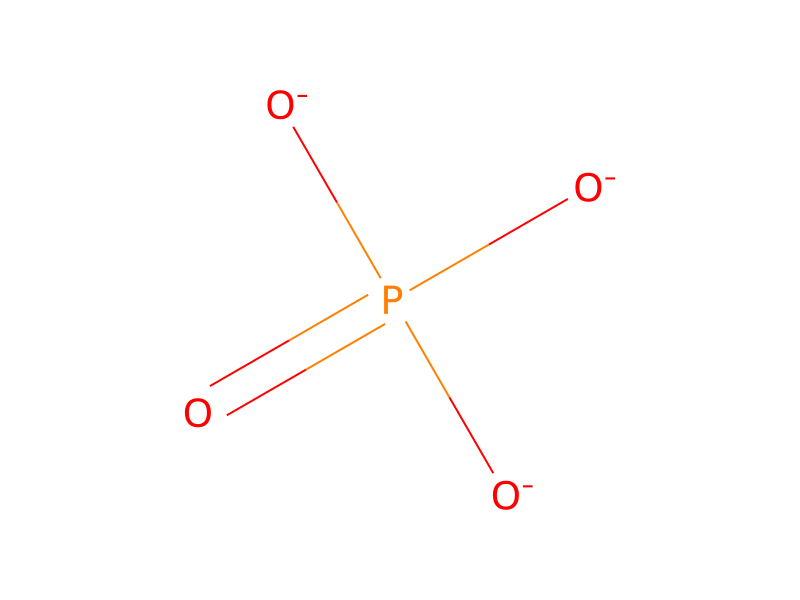
[P:1]([OH:5])([O-:4])([O-:3])=[O:2].[Na+].[Na+].P(=O)(O)(O)O.[O-:13][P:14]([O:17][P:18]([O-:21])([O-:20])=[O:19])(=[O:16])[O-:15].[K+].[K+].[K+].[K+].OP([O-])(O)=O.[K+].[Na].[O-]P1(OP([O-])(=O)OP([O-])(=O)OP([O-])(=O)OP([O-])(=O)OP([O-])(=O)O1)=O.[Na+].[Na+].[Na+].[Na+].[Na+].[Na+].[O-]P(=O)=O.[Na+]>O>[P:1]([O-:5])([O-:4])([O-:3])=[O:2].[O-:15][P:14]([O:17][P:18]([O-:21])([O-:20])=[O:19])(=[O:13])[O-:16]Participants
Reactant 7


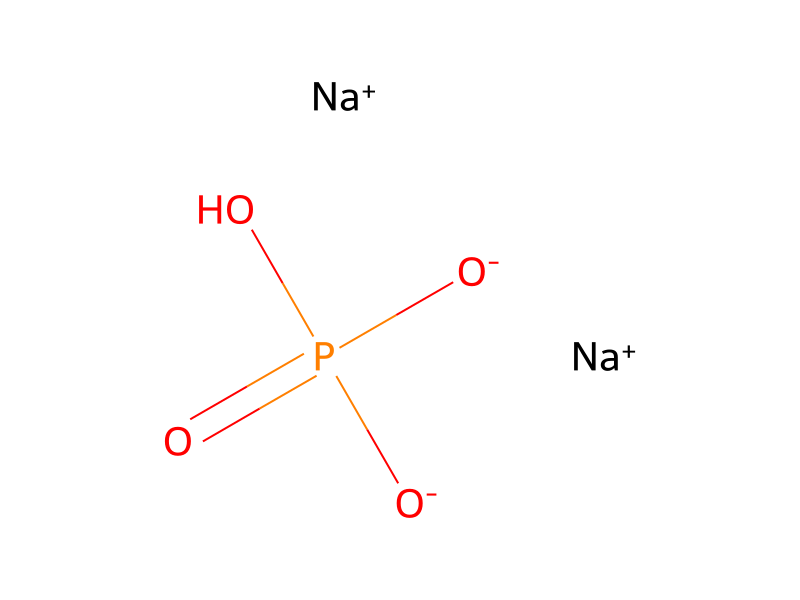



Product 2

Reagents, catalysts & solvents 1
Conditions
- Temperature
- 100 °C
Procedure
If this is unobjectionable for ecological reasons, the known alkali phosphates, in particular trisodium polyphosphate, may also be used as builders. Alkali phosphate is the general term for the alkali metal salts (in particular sodium and potassium salts) of the various phosphoric acids, where a distinction may be made between metaphosphoric acids (HPO3)n and orthophosphoric acid H3PO4 plus higher-molecular weight representatives. The phosphates combine several advantages: they act as alkali carriers, prevent lime deposits on machine parts and/or lime encrustations on fabrics and also contribute toward the cleaning effect. Sodium dihydrogen phosphate NaH2PO4 exists as the dihydrate (density 1.91 gcm−3, melting point 60° C.) and as the monohydrate (density 2.04 gcm−3). Both salts are white powders that dissolve very easily in water, lose their water of crystallization when heated and form the weakly acidic diphosphate (disodium hydrogen diphosphate Na2H2P2O7) at 200° C., forming sodium trimetaphosphate (Na3P3O9) and Madrell's salt at higher temperatures. NaH2PO4 gives an acid reaction; it is formed when phosphoric acid is adjusted to a pH of 4.5 with sodium hydroxide solution and the slurry is sprayed. Potassium dihydrogen phosphate (primary or monobasic potassium phosphate, potassium biphosphate KDP), KH2PO4 is a white salt with the density 2.33 gcm−3, having a melting point of 253° C. (decomp. with the formation of (KPO3)x, potassium polyphosphate) and is readily soluble in water. Disodium hydrogen phosphate (secondary sodium phosphate) Na2HPO4 is a colorless very readily water-soluble crystalline salt which exists in an anhydrous form and with 2 mol of water (density 2.066 gcm−3, water loss at 95° C.), 7 mol (density 1.68 gcm3, melting point 48° C. with the loss of 5H2O) and 12 mol water (density 1.52 gcm3, melting point 35° C. with a loss of 5H2O), become anhydrous at 100° C. and forms the diphosphate Na4P2O7 when heated to a greater extent. Disodium hydrogen phosphate is synthesized by neutralizing phosphoric acid with soda solution using phenolphthalein as an indicator. Dipotassium hydrogen phosphate (secondary or dibasic potassium phosphate), K2HPO4 is an amorphous white salt which is readily soluble in water. Trisodium phosphate, tertiary sodium phosphate Na3PO4 forms colorless crystals which as the dodecahydrate have a density of 1.62 gcm−3 and a melting point of 73-76° C. (decomp.), as the decahydrate (corresponding to 19-20% P2O5) have a melting point of 100° C. and in anhydrous form (corresponding to 39-40% P2O5) have a density of 2.536 gcm−3. Trisodium phosphate is readily soluble in water with an alkaline reaction and is prepared by evaporating a solution of exactly 1 mol disodium phosphate and 1 mol NaOH. Tripotassium phosphate (tertiary or tribasic potassium phosphate), K3PO4, is a white deliquescing granular powder with a density of 2.56 gcm−3, has a melting point of 1340° C. and is readily soluble in water with an alkaline reaction. It is formed, for example, when Thomas slag is heated with coal and potassium sulfate. Despite the higher price, the more readily soluble and therefore highly effective potassium phosphates are often preferred in the cleaning agent industry in comparison with the corresponding sodium compounds. Tetrasodium diphosphate (sodium pyrophosphate), Na4P2O7 exists in an anhydrous form (density 2.534 gcm3, melting point 988° C. also given as 880° C.) and as the decahydrate (density 1.815-1.836 gcm3, melting point 94° C. with the loss of water). Both substances are colorless crystals which dissolve in water with an alkaline reaction. Na4P2O7 is formed on heating disodium phosphate to >200° C. or by reacting phosphoric acid with soda in a stoichiometric ratio and dehydrating the solution by spraying. The decahydrate can chelate heavy metal salts and the salts responsible for hard water and therefore reduces the hardness of water. Potassium diphosphate (potassium pyrophosphate), K4P2O7 exists in the form of the trihydrate and is a colorless hygroscopic powder with the density 2.33 gcm−3, which is soluble in water; the pH of the 1% solution at 25° C. is 10.4. By condensation of NaH2PO4 and/or KH2PO4, higher-molecular sodium and potassium phosphates are formed, a distinction being made between cyclic compounds, the sodium and/or potassium metaphosphates, and chain compounds, the sodium and/or potassium polyphosphates. A variety of terms are in use for the later in particular: melt phosphates or calcined phosphates, Graham's salt, Kurrol's salt and Madrell's salt. All higher sodium and potassium phosphates are referred to jointly as condensed phosphates. Pentasodium triphosphate Na5P3O10 (sodium tripolyphosphate) which is important industrially is a white, nonhygroscopic water-soluble salt that is anhydrous or crystallizes with 6H2O and has the general formula NaO—[P(O)(ONa)—O]n—Na, where n=3. At room temperature approx. 17 g of the anhydrous salt will dissolve in 100 g water, at 60° C. approx 20 g will dissolve and at 100° C. approx. 32 g; after heating the solution for 2 hours at 100° C., approx. 8% orthophosphate and 15% diphosphate are formed by hydrolysis. In the synthesis of pentasodium triphosphate, phosphoric acid is reacted with soda solution or sodium hydroxide solution in a stoichiometric ratio and the solution is dehydrated by spraying. Like Graham's salt and sodium diphosphate, pentasodium triphosphate will dissolve many insoluble metal compounds (including lime soaps, etc.). Pentapotassium triphosphate K5P3O10 (potassium tripolyphosphate) is marketed in the form of a 50 wt % solution (>23% P2O5, 25% K2O), for example. The potassium polyphosphates are used widely in the washing and cleaning agent industry. In addition, there are also sodium-potassium tripolyphosphates which may also be used within the scope of the present invention. These are formed, for example, when sodium trimetaphosphate is hydrolyzed with KOH: (NaPO3)3+2KOH→Na3K2P3O10+H2O.
Workup
- customat 25° C.
- customare formed
- customcrystallizes with 6H2O
- customAt room temperature approx
- dissolution17 g of the anhydrous salt will dissolve in 100 g water, at 60° C. approx 20 g
- dissolutionwill dissolve and at 100° C. approx
Sources & evidence
- ORD record
- ord-77d80451b07f423f95dc1df999acad3e
- Source dataset
- uspto-grants-2011_10
- Patent number
- US08044011B2
Reaction notes
Loading…