Diisopropylethylamine → HCID 24968689, compound
Reaction equation

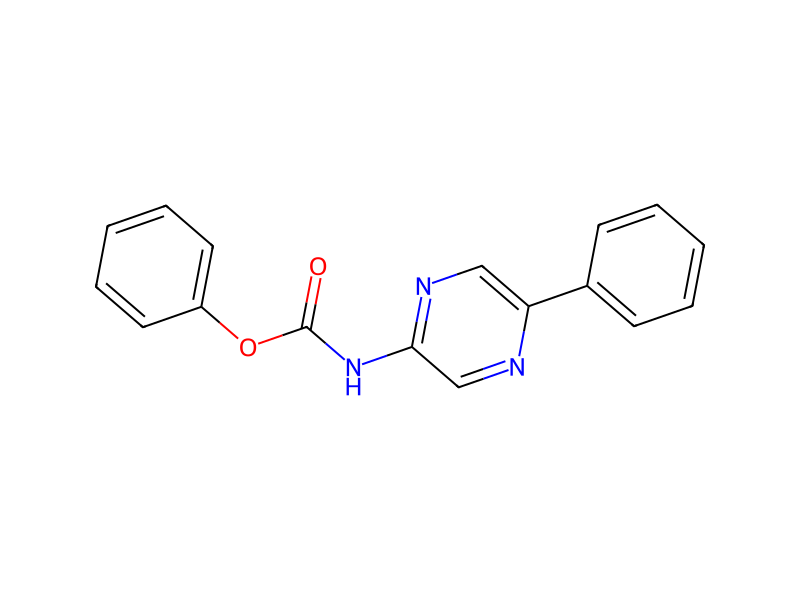
Cl.[NH:2]1[CH2:7][CH2:6][C:5](=[CH:8][C:9]2[CH:10]=[C:11]([CH:23]=[CH:24][CH:25]=2)[O:12][C:13]2[CH:18]=[CH:17][C:16]([C:19]([F:22])([F:21])[F:20])=[CH:15][N:14]=2)[CH2:4][CH2:3]1.[C:26]1([C:32]2[N:33]=[CH:34][C:35]([NH:38][C:39](=O)[O:40]C3C=CC=CC=3)=[N:36][CH:37]=2)[CH:31]=[CH:30][CH:29]=[CH:28][CH:27]=1.C(N(C(C)C)CC)(C)C>CS(C)=O>[C:26]1([C:32]2[N:33]=[CH:34][C:35]([NH:38][C:39]([N:2]3[CH2:7][CH2:6][C:5](=[CH:8][C:9]4[CH:25]=[CH:24][CH:23]=[C:11]([O:12][C:13]5[CH:18]=[CH:17][C:16]([C:19]([F:22])([F:20])[F:21])=[CH:15][N:14]=5)[CH:10]=4)[CH2:4][CH2:3]3)=[O:40])=[N:36][CH:37]=2)[CH:27]=[CH:28][CH:29]=[CH:30][CH:31]=1Participants
Reactant 3


Product 1

Reagents, catalysts & solvents 1

Conditions
- Temperature
- 60 °C
Procedure
A solution of 2-(3-piperidin-4-ylidenemethyl-phenoxy)-5-trifluoromethyl-pyridine hydrochloride (0.371 g, 1.00 mmol) (from Example 1, Step 5) and phenyl 5-phenylpyrazin-2-ylcarbamate (0.291 g, 1.00 mmol) in DMSO (2.5 mL) was treated with diisopropylethylamine (0.155 g, 1.2 mmol) and heated to 60° C. After 3 h, the reaction mixture was partitioned between water and ethyl acetate. The organic layer was separated and the aqueous layer was extracted again with ethyl acetate. The combined organic layers were washed with brine and dried over sodium sulfate, filtered and concentrated. The residue was purified by silica gel chromatography (10% of the 1N NH3 in MeOH, in dichloromethane) to afford the title compound (200 mg, 37%) as white crystals after trituration in diethyl ether. MS (APCI 10V) AP+ 532.25; 1H NMR (400 MHz, DMSO-d6) δ ppm 2.34 (t, J=5.46 Hz, 2H) 2.46 (t, J=5.46 Hz, 2H) 3.46 (t, J=5.46 Hz, 2H) 3.50 (t, J=5.46 Hz, 2H) 6.37 (s, 1H) 6.69 (d, J=8.77 Hz, 1H) 7.01-7.03 (m, 2H) 7.10 (d, J=7.81 Hz, 1H) 7.19 (d, J=8.59, Hz, 1H) 7.35-7.39 (m, 2H) 7.43-7.47 (m, 2H) 8.02 (dd, J=7.03 Hz, 1.95 Hz, 2H) 8.17 (dd, J=8.78 Hz, 2.15 Hz, 1H) 8.53 (d, J=2.5 Hz, 1H) 8.85 (s, 1H) 9.04 (s, 1H) 9.63 (s, 1H).
Workup
- customthe reaction mixture was partitioned between water and ethyl acetate
- customThe organic layer was separated
- extractionthe aqueous layer was extracted again with ethyl acetate
- washThe combined organic layers were washed with brine
- dry with materialdried over sodium sulfate
- filtrationfiltered
- concentrationconcentrated
- customThe residue was purified by silica gel chromatography (10% of the 1N NH3 in MeOH
Sources & evidence
- ORD record
- ord-14c9e289e34d417dbf0ec568b8465d1f
- Source dataset
- uspto-grants-2011_10
- Patent number
- US08044052B2
Reaction notes
Loading…