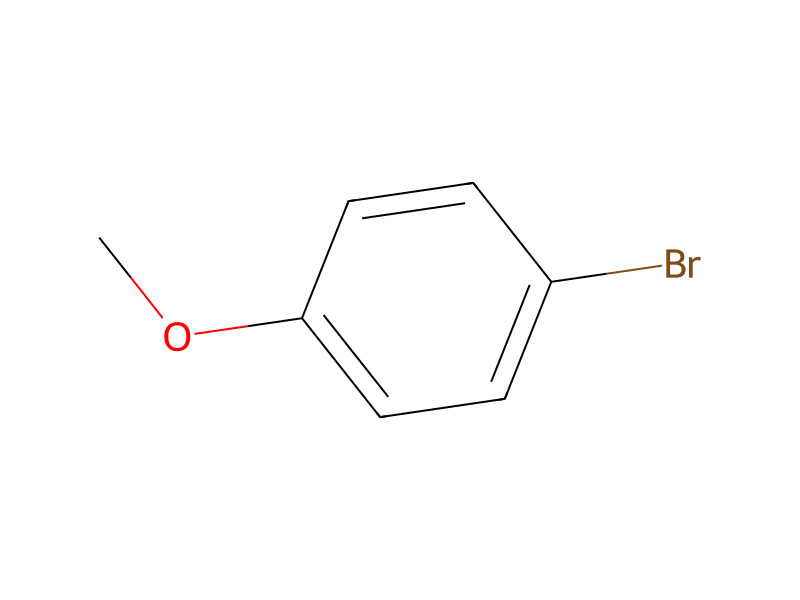
4-Bromoanisole → HCID 57825023, compound
Reaction equation

Br[C:2]1[CH:7]=[CH:6][C:5]([O:8][CH3:9])=[CH:4][CH:3]=1.[Mg].[CH3:11][C:12]([C:14]1[CH:19]=[CH:18][CH:17]=[C:16]([Br:20])[CH:15]=1)=O>C(OCC)C>[Br:20][C:16]1[CH:15]=[C:14]([C:12]([C:2]2[CH:7]=[CH:6][C:5]([O:8][CH3:9])=[CH:4][CH:3]=2)=[CH2:11])[CH:19]=[CH:18][CH:17]=1Participants
Reactant 3


Product 1

Reagents, catalysts & solvents 1

Procedure
4-Bromoanisole (2.2 mL, 0.017 mol) in diethyl ether (10 mL) was added to a mixture of magnesium turnings (0.5 g, 0.02 mol) in diethyl ether (5 mL), at room temperature. The resulting mixture was heated to reflux for 1 h. The mixture was then cooled to room temperature. A solution of 3-bromoacetophenone (3.4 g, 0.017 mol) in diethyl ether was then added dropwise causing a gentle reflux. After 3 h heating to reflux the reaction mixture was examined by LC-MS which showed complete conversion to the desired product. The mixture was quenched with 1 N HCL solution (20 mL). Ethyl acetate (20 mL) was added and the aqueous phase was separated. The aqueous phase was then extracted with ethyl acetate (2×20 mL). The combined organic layers were dried over sodium sulfate, filtered and concentrated to dryness under vacuum. The crude was then dissolved in toluene (10 mL) and a catalytic amount of p-toluene sulfonic acid (30 mg) was added and refluxed for 3 h. The solvent was removed and the crude residue was purified by column chromatography (cyclohexane) to afford the title compound as a colourless oil (3.7 g, 74%).
Workup
- temperatureThe resulting mixture was heated
- temperatureto reflux for 1 h
- temperatureAfter 3 h heating
- temperatureto reflux the reaction mixture
Sources & evidence
- ORD record
- ord-8322477aa9894c8c8103b3745ef0e9a5
- Source dataset
- uspto-grants-2011_08
- Patent number
- US07989449B2
Reaction notes
Loading…