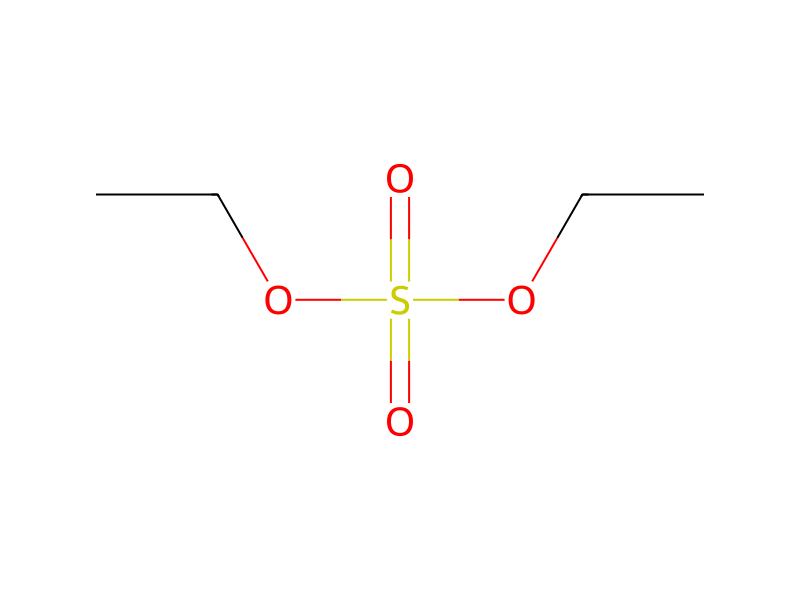
Diethyl Sulfate → 1,3-Dibromo-5-ethoxybenzene
Reaction equation

[Br:1][C:2]1[CH:3]=[C:4]([OH:9])[CH:5]=[C:6]([Br:8])[CH:7]=1.C(=O)([O-])[O-].[K+].[K+].S(OCC)(O[CH2:20][CH3:21])(=O)=O>CC(=O)CC.ClCCl>[Br:1][C:2]1[CH:3]=[C:4]([O:9][CH2:20][CH3:21])[CH:5]=[C:6]([Br:8])[CH:7]=1Participants
6
Reactant 3


Product 1

Reagents, catalysts & solvents 2


Conditions
- Temperature
- 90 °C
Procedure
A dispersion of 3,5-dibromophenol (0.398 g, 1.6 mmol) and potassium carbonate (0.437 g, 3.2 mmol) in 2-butanone (4 mL) was treated with diethyl sulfate (0.246 g, 1.6 mmol) and the reaction mixture heated at 90° C. for 15 hours. The resulting thick suspension was cooled to room temperature, diluted with dichloromethane and extracted with water. The organic layer was separated, dried over sodium sulfate and evaporated under reduced pressure. The title compound was obtained as a light brown oil (0.38 g, 86% of theory) which was used in the next step without further purification.
Workup
- temperatureThe resulting thick suspension was cooled to room temperature
- extractionextracted with water
- customThe organic layer was separated
- dry with materialdried over sodium sulfate
- customevaporated under reduced pressure
Sources & evidence
- ORD record
- ord-e8ad1ba1c21a4873b750436bb00270fe
- Source dataset
- uspto-grants-2011_08
- Patent number
- US07989449B2
Reaction notes
Loading…