2-Nitrobenzoic acid → HCID 21133924, compound
Reaction equation

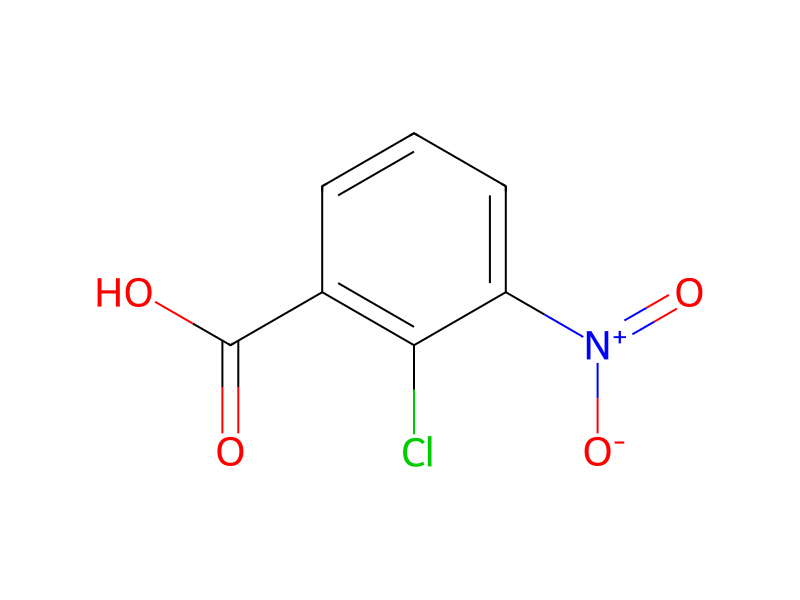
[Cl:1][C:2]1[C:10]([N+:11]([O-])=O)=[CH:9][CH:8]=[CH:7][C:3]=1[C:4]([OH:6])=[O:5].[N+]([C:17]1C=CC=C[C:18]=1C(O)=O)([O-])=O.[NH4+].[Cl-]>C1COCC1>[Cl:1][C:2]1[C:3]([C:4]([OH:6])=[O:5])=[CH:7][CH:8]=[C:9]2[C:10]=1[NH:11][CH:18]=[CH:17]2Participants
Reactant 3


Product 1

Reagents, catalysts & solvents 1

Conditions
- Temperature
- -45 °C
Procedure
A two liter 3-neck flask was assembled with an overhead stir, flame dried and flushed with nitrogen. To this was added 1.0 equivalent of 2-chloro-3-nitrobenzoic acid (30 grams, 148.8 mmol) in 300 mL dry THF. The flask was then cooled to −45° C. with the aid of an ethanol/dry ice bath. 4.0 equivalents of cold Vinyl Grignard reagent (Aldrich, 1M Sure/Seal™ bottles) was then cannulated into the solution of nitrobenzoic acid. An additional 100 mL of dry THF was then added via cannula to the very thick solution. The flask was allowed to slowly warm to room temperature overnight. In the morning, the flask was cooled to 0° C. with an ice bath and 400 mL of saturated NH4Cl was added in four portions. The mixture was stirred for one hour then transferred to a separatory funnel and extracted with ethyl acetate (300 mL×3). The organic layers were combined, washed with brine (100 mL), dried over MgSO4 and evaporated to dryness on the rotovap. The aqueous layer was acidified to pH=2 with 2M HCl. The resulting solid was filtered, combined with the above isolated solid and dried in a vacuum desiccator over night to yield 26.32 grams (90%) of a tan powder that was used without further purification. 1H NMR (300 MHz): (CD3OD) δ 7.59 (d, J=8.42 Hz, 1H), 7.49 (d, J=8.42 Hz, 1H), 7.42 (d, J=2.93 Hz, 1H), 6.53 (d, J=2.93 Hz, 1H); Analytical HPLC method: Solvent A=10% MeOH-90% H2O-0.1% TFA, Solvent B=90% MeOH-10% H2O-0.1% TFA, Start % B=0, Final % B=100, Gradient time=2 min, Flow Rate=5 ml/min, Column: Xterra MS C18 S7 3.0×50 mm; LC/MS: (ES+) m/z (M+H)+=195.92, 197.92, HPLC Rt=1.018 min.
Workup
- customA two liter 3-neck flask was assembled with an overhead
- temperatureflame
- customdried
- customflushed with nitrogen
- temperatureto slowly warm to room temperature overnight
- temperatureIn the morning, the flask was cooled to 0° C. with an ice bath
- stirringThe mixture was stirred for one hour
- customthen transferred to a separatory funnel
- extractionextracted with ethyl acetate (300 mL×3)
- washwashed with brine (100 mL)
- dry with materialdried over MgSO4
- customevaporated to dryness on the rotovap
- filtrationThe resulting solid was filtered
- customabove isolated solid
- customdried in a vacuum desiccator over night
Sources & evidence
- ORD record
- ord-883db3d2d7ee45f6bea9e86b9d0b2975
- Source dataset
- uspto-grants-2011_08
- Patent number
- US07998951B2
Reaction notes
Loading…