Diisopropylethylamine → HCID 59149738, compound
Reaction equation

Cl[C:2]1[CH:3]=[CH:4][C:5]2[N:6]([C:8]([C:11]([F:14])([F:13])[F:12])=[N:9][N:10]=2)[N:7]=1.Cl.[CH3:16][O:17][C:18]1[CH:23]=[CH:22][C:21]([CH:24]2[CH2:28][CH2:27][NH:26][CH2:25]2)=[CH:20][CH:19]=1.CCN(C(C)C)C(C)C>C(O)C>[CH3:16][O:17][C:18]1[CH:19]=[CH:20][C:21]([CH:24]2[CH2:28][CH2:27][N:26]([C:2]3[CH:3]=[CH:4][C:5]4[N:6]([C:8]([C:11]([F:14])([F:13])[F:12])=[N:9][N:10]=4)[N:7]=3)[CH2:25]2)=[CH:22][CH:23]=1Participants
5

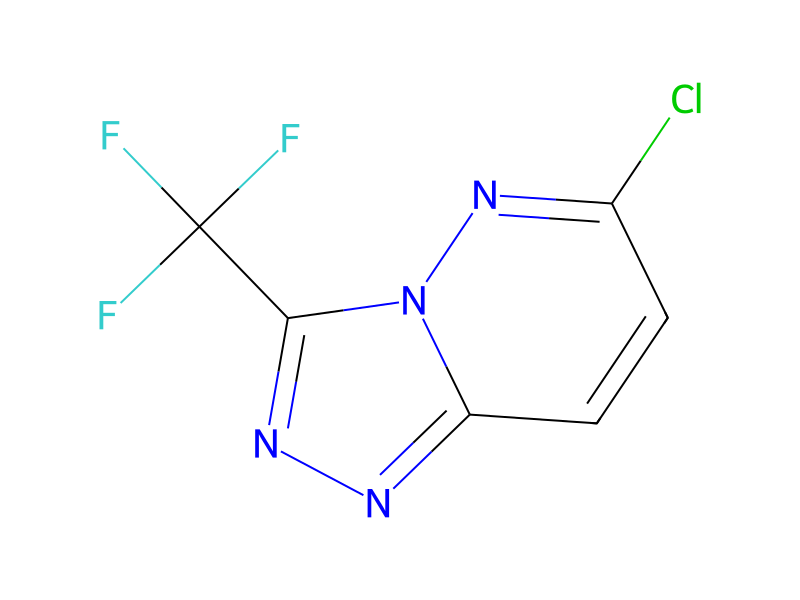



Conditions
- Temperature
- 70 °C
Procedure
A solution of 6-chloro-3-(trifluoromethyl)-[1,2,4]triazolo[4,3-b]pyridazine (50 mg, 0.22 mmol) in ethanol (1 mL) was added to 3-(4-methoxyphenyl)pyrrolidine hydrochloride (71 mg, 0.33 mmol). The reaction mixture was treated with DIPEA (86 mg, 0.66 mmol) and the mixture was heated at 70° C. for 16 hours. The reaction mixture was evaporated to leave an involatile residue that was purified by preparative reverse phase chromatography to give 6-[3-(4-methoxyphenyl)pyrrolidin-1-yl]-3-(trifluoromethyl)[1,2,4]triazolo[4,3-b]pyridazine (45 mg, 55%).
Workup
- customThe reaction mixture was evaporated
- customto leave an involatile residue that
- customwas purified by preparative reverse phase chromatography
Sources & evidence
- ORD record
- ord-80e6fc53a4b64cfaa626d2ad726a1f49
- Source dataset
- uspto-grants-2011_08
- Patent number
- US08003649B2
Reaction notes
Loading…