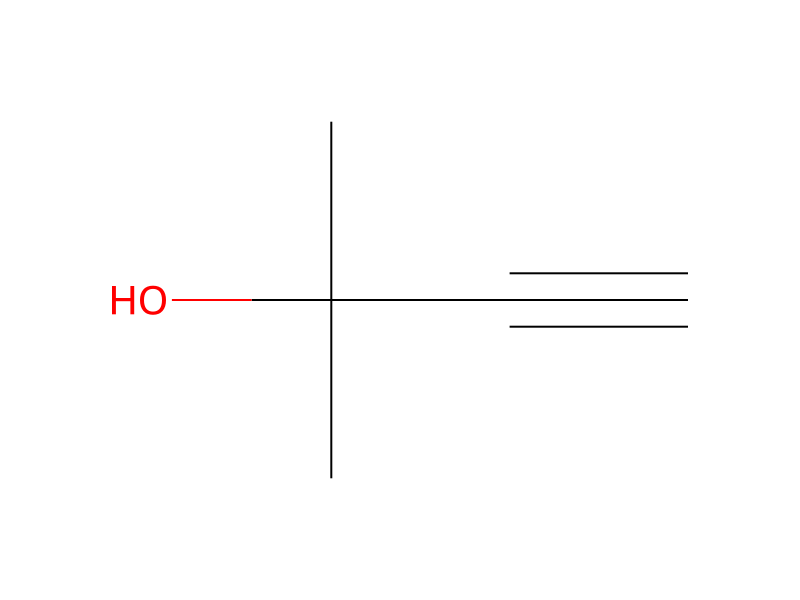
2-Methyl-3-butyn-2-ol → 2-pentadecanone, 6,10,14-trimethyl-
Reaction equation

CC(O)(C#C)C.[CH3:7][C:8]([OH:27])([CH2:11][CH2:12][CH2:13][CH:14]([CH3:26])[CH2:15][CH2:16][CH2:17][CH:18]([CH3:25])[CH2:19][CH2:20][CH2:21][CH:22]([CH3:24])[CH3:23])C#C.[OH-].[K+]>>[CH3:26][CH:14]([CH2:15][CH2:16][CH2:17][CH:18]([CH3:25])[CH2:19][CH2:20][CH2:21][CH:22]([CH3:24])[CH3:23])[CH2:13][CH2:12][CH2:11][C:8](=[O:27])[CH3:7]Participants
4



Procedure
A 100 ml-four-necked flask equipped with a thermometer, a reflux condenser, and a stirrer was charged with 8.61 g (102) mmol 2-methyl-3-butin-2-ol (MBI) and 30.14 g (102 mmol) 3,7,11,15-tetramethyl-1-hexadecin-3-ol (DIP) stirred with 750 rpm and heated up to reflux temperature. After 5 min an internal temperature of 95° C. was reached, and 2 ml KOH (41.42% in H2O, 20.53 mmol) were added. The reaction was controlled by GC (samples were taken after 60 min, 155 min and 385 min). The ketones were separated by distillation. Yield acetone 5.8 g, (97.5%), yield 6,10,14-trimethyl-2-pentadecanon (C18—K) 26.1 g, (96.1%), not optimized.
Workup
- customA 100 ml-four-necked flask equipped with a thermometer, a reflux condenser, and a stirrer
- temperatureheated up
- temperatureto reflux temperature
- customwas controlled by GC (samples were taken after 60 min, 155 min and 385 min)
- customThe ketones were separated by distillation
Sources & evidence
- ORD record
- ord-607e22cbd9ff4ddc90b7b0a60b0382a3
- Source dataset
- uspto-grants-2011_08
- Patent number
- US08003843B2
Reaction notes
Loading…