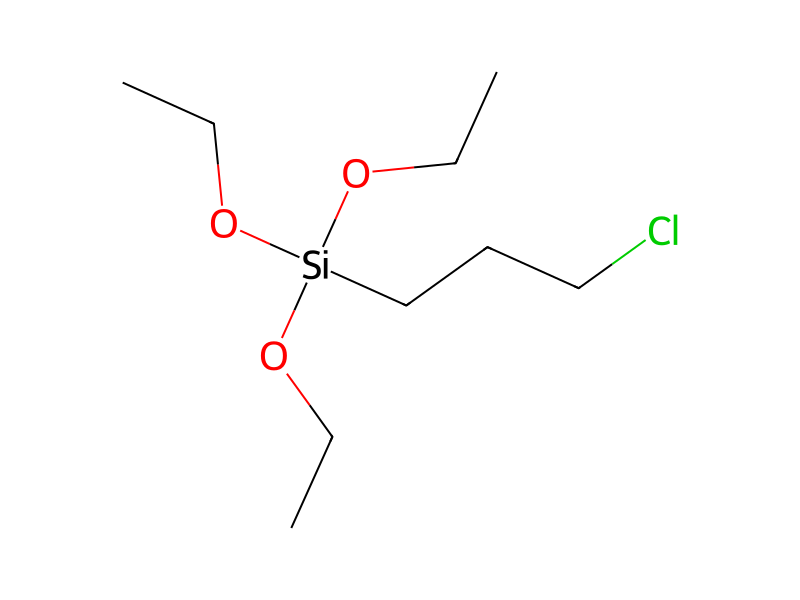
(3-Chloropropyl)triethoxysilane → Octanethioic acid, S-(3-(triethoxysilyl)propyl) ester
Reaction equation

[C:1]([O-:10])(=[S:9])[CH2:2][CH2:3][CH2:4][CH2:5][CH2:6][CH2:7][CH3:8].[Na+].Cl[CH2:13][CH2:14][CH2:15][Si:16]([O:23][CH2:24][CH3:25])([O:20][CH2:21][CH3:22])[O:17][CH2:18][CH3:19]>[Br-].C([N+](CCCC)(CCCC)CCCC)CCC>[C:1]([S:9][CH2:13][CH2:14][CH2:15][Si:16]([O:17][CH2:18][CH3:19])([O:23][CH2:24][CH3:25])[O:20][CH2:21][CH3:22])(=[O:10])[CH2:2][CH2:3][CH2:4][CH2:5][CH2:6][CH2:7][CH3:8]Participants
Reactant 2

Product 1

Reagents, catalysts & solvents 1

Procedure
The aqueous solution of sodium thiooctanoate was heated to 80° C. and stirred with a mechanical stirrer throughout this procedure. To this solution was added, all at once, 4 grams of a concentrated aqueous solution of tetrabutylammonium bromide. Immediately thereafter was added a solution of 3-chloro-1-propyltriethoxysilane (120 grams, 0.5 moles). This mixture was kept at 80° C. with continued stirring for 6 hours, and then allowed to cool to ambient temperature. After cooling to ambient temperature, the organic phase was separated from the aqueous phase. Gas chromatography and mass spectrometry (GC and GCMS) revealed a product containing 93% 3-octanoylthio-1-propyltriethoxysilane. Product identity using this process confirmed by nuclear magnetic resonance spectroscopy (NMR).
Workup
- additionTo this solution was added
- customwas kept at 80° C.
- stirringwith continued stirring for 6 hours
- temperatureAfter cooling to ambient temperature
- customthe organic phase was separated from the aqueous phase
- additioncontaining 93% 3-octanoylthio-1-propyltriethoxysilane
Sources & evidence
- ORD record
- ord-5647c4cfa2c244998fad25c5064ebbfe
- Source dataset
- uspto-grants-2011_08
- Patent number
- US08008524B2
Reaction notes
Loading…